


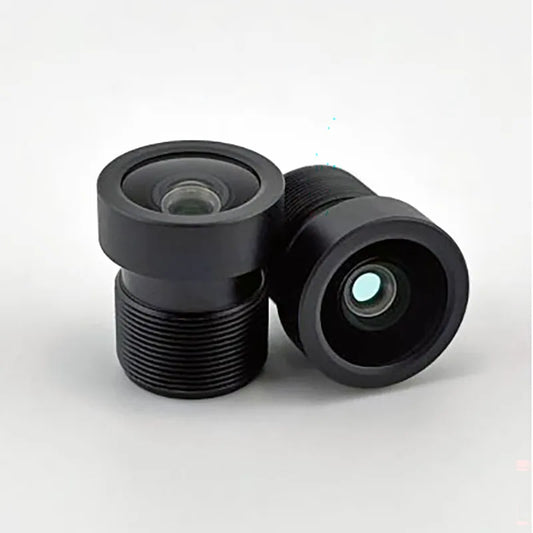
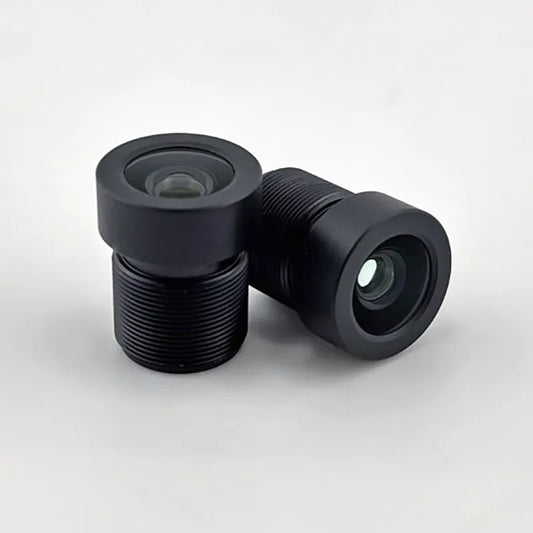
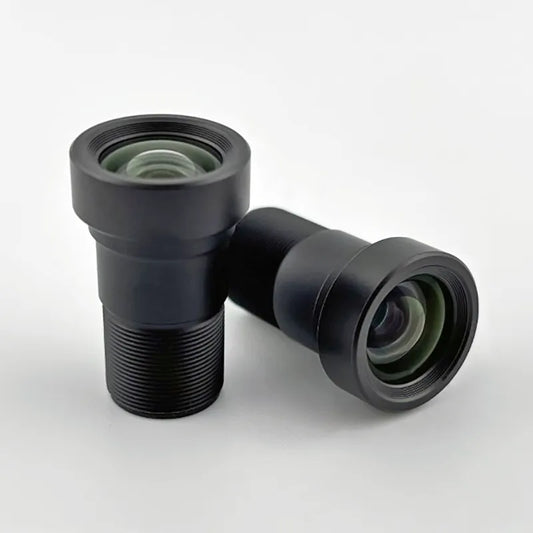
組み込みセンサーにレンズを合わせる方法
レンズとセンサーのミスマッチは、ヴィネット現象、色むら、あるいは解像度の低下として現れます。以下の4つのパラメータを整合させる必要があります。すなわち、イメージサークルとセンサーの対角線、CRAとセンサーのマイクロレンズ設計、レンズのMTFとセンサーのナイキスト周波数、そして後焦点距離とセンサースタックです。
イメージサークルはセンサーの対角線を覆う必要がある
The lens projects a circular image; your rectangular sensor sits inside that circle. An image circle smaller than the sensor diagonal produces vignetting at the corners. Moderate oversizing is usually acceptable for coverage; run the same CRA, clearance, stack, and MTF checks as any pairing. Undersizing vignettes the corners and fails whenever the image must fill the full frame. Circular-image fisheyes that place the whole image circle inside the frame are the deliberate exception.
| センサーフォーマット | 対角線 |
|---|---|
| 1/4インチ | 4.5mm |
| 1/3インチ | 6.0mm |
| 1/2.5インチ | 7.2mm |
| 1/2.3インチ(IMX477クラス) | 7.9mm |
| 1/1.7インチ | 9.5mm |
1/2.5インチセンサー対応と記載されたレンズは、そのサイズ以下のセンサーであればすべてカバーしますが、1/1.7インチセンサーではヴィネット現象が発生します。データシートには、イメージサークルがミリメートル単位またはセンサーフォーマットの表記で記載されていますが、これら2つの表記の精度が必ずしも一致しているとは限りません。そのため、メーカー間のフォーマット表記が完全に一致していると仮定するのではなく、お使いのセンサーの実際の対角線長と照らし合わせて確認してください。カバー範囲の計算に関する詳細は、「センサーサイズとレンズの互換性」をご覧ください。
解像度:レンズのMTFは、センサーのナイキスト周波数を上回っていなければならない
A 12MP sensor with 1.55µm pixels has a monochrome Nyquist frequency near 322 lp/mm, and a Bayer sensor samples each color channel more coarsely than that. If the lens cannot resolve the frequency your task needs at your working aperture, the sensor's extra resolution goes to waste. Check the lens MTF chart at the aperture you intend to shoot.
Commonlands uses 20%-30% MTF at Nyquist as a starting point for embedded work, not a standard: what you actually need follows the contrast and SNR of the task, how much aliasing the pipeline tolerates, and which field positions carry the measurement. Validate it against your own images. The MTF curve guide explains how to read these charts.
焦点距離の計算を直接行う
Run your sensor size, target field of view, and working distance through the field of view calculator or the EFL calculator to get the required focal length for your system, consistent with the same formula used above.
主光線の角度が組み込みカメラの画質に与える影響
Chief ray angle (CRA) is the angle at which the lens delivers light to a given point on the sensor. Small-pixel sensors, common at 1.4µm-2.5µm in embedded cameras, use microlenses over each pixel tuned to a specific CRA curve. That curve runs from roughly 0 to 15 degrees at the edge on industrial and machine vision sensors, up to 25 to 35 degrees on mobile-class parts, so pull the curve for your sensor rather than assuming a typical value. When the lens CRA does not track the sensor's design CRA, you get color shading (red, green, and blue channels fall off differently toward the edges) and reduced corner brightness that software cannot fully correct, because the mismatch is wavelength- and angle-dependent at the pixel level rather than a uniform gain error.
This matters most on the small-pixel sensors that dominate embedded and board-camera designs. Sensor datasheets specify a CRA curve; lens datasheets specify a matching CRA spec or curve. When selecting a lens for a sensor with sub-2µm pixels, check that the two curves track across the field, not just at the center. Curve overlap is a screen, not an acceptance test: the tolerable difference depends on the full ray cone at each field point, so on working F-number, plus the wavelength band, the pixel and filter stack, and the corner shading and MTF loss your pipeline accepts. Settle it with flat-field and corner MTF measurements. The full mismatch mechanics and matching procedure are in the chief ray angle and mismatch guide.
CRAの不整合は、セットアップ段階では見落としがちです。なぜなら、画面中央部の画質は問題ないように見えるからです。この問題は、画面の隅やエッジ部分に現れ、多くの場合、特定の照明条件下でのみ発生するか、センサーの改訂によりマイクロレンズの設計が変更された後に初めて明らかになります。新しいカメラモジュールにレンズを採用する際は、現場で色むらが現れてからではなく、事前にCRAの互換性を確認してください。
JetsonおよびRaspberry Piカメラモジュールにおけるボードレベルでの統合

MIPI CSI-2 is an electrical interface between the sensor and the host processor, not a lens mount, and no compute platform defines one. Mount style belongs to the camera board. Plenty of Jetson and Raspberry Pi camera boards do carry an M12 holder soldered or clipped to the PCB, which is why M12 dominates this space, but Raspberry Pi's own line covers three cases: fixed integrated optics on Camera Module 2 and Camera Module 3, and the High Quality Camera, sold both in a C/CS-mount version that ships with a C-mount adapter and in a native M12-mount version.
Common sensors on these boards are the IMX477 (High Quality Camera), IMX219 (Camera Module 2), and IMX708 (Camera Module 3). Read the mechanical drawing for the board you are building on before ordering a lens. Because M12 has no standardized flange distance, focus is set entirely by how far the lens threads into the holder, and back focal length (BFL) varies by lens design.
That variability helps at the board level. When the same lens design moves onto a module whose cover glass and IR filter stack is a different thickness, a holder of the correct height brings the sensor back to the lens's focus position, which is cheaper than requalifying a lens. Confirm holder height against the lens's specified back focal length and your full sensor stack (bare sensor, cover glass, IR filter, any spacer) before finalizing the PCB footprint. The M12 lens holder selection guide covers holder height selection and thread engagement in detail.
Holder height only buys back focus. A thicker or thinner plane-parallel stack sitting in a converging beam adds its own spherical aberration and axial color, and any wedge in that stack tilts the image plane. Moving the lens along the axis corrects none of that.
A different filter also moves the passband, shifting where an IR-corrected design lands in focus, and an interference cut filter shifts its cut-off with ray angle, so the corner response moves differently from the center. Measure corner MTF and color shading on the new module rather than assuming the refocus closed the gap.
Multi-camera Jetson and Raspberry Pi designs raise the integration bar further. A stereo pair should be closely matched in focal length and distortion profile, because those set the disparity-to-range scale and the rectification accuracy, and the rig needs synchronized exposure plus extrinsics that hold their calibration. Back focal length is the one difference that does not need matching: each module is focused individually, which absorbs it.
Bulk-buying from a single production lot reduces optical unit-to-unit spread but does not eliminate it, so verify focus at the corners of the field on each unit during bring-up, not only at the center.
「性能・サイズ・コスト」の三要素
組み込み用レンズの選定は、光学性能、物理的な設置面積、単位コストという3つの要素のトレードオフであり、消費電力は設置面積と関連する二次的な要素となります。固定式の産業用検査ステーションとは異なり、組み込みシステムでは通常、この三角形のいずれか一方の要素にリソースを集中させる場合、他の2つの要素を犠牲にせざるを得ません。
M12 lenses sit at the small-footprint, low-cost corner. A 3g-15g lens with a fixed aperture draws no power itself and costs a fraction of an industrial optic, but gives up the adjustable iris and ring-driven focus that C-mount designs such as Commonlands' provide. C-mount and CS-mount sit at the opposite corner: an iris ring lets you trade depth of field for light throughput on demand and a focus ring refocuses without re-threading the lens, but the lens weighs 3x-10x more and costs more per unit. For a drone or handheld device on battery power, that weight difference is a meaningful chunk of flight time or user fatigue, not just a spec sheet number.
絞り制御は、あまり目立たない形で光量とも相互作用します。 Cマウントの可変絞り機構がマシンビジョン分野で実用的なのは、照明が通常プログラムによって制御されている(構造化照明、LEDリングライト、バックライトアレイなど)ため、センサーへの光量を損なうことなく、被写界深度を確保するために絞りを絞ることができるからです。周囲光や制御不能な照明に依存する組み込みシステムでは、必ずしもそのようなトレードオフが可能とは限らないため、代わりに、F値の小さい固定絞りM12レンズが選ばれる傾向があります。
ほとんどの組み込み設計では、デフォルトで固定開口部のM12が採用され、絞り制御の欠如は容認されています。Cマウントは、高解像度検査モジュールや、特定の耐環境仕様のSKUを必要とする屋外用筐体など、一部の組み込みアプリケーションに限定して使用されており、そこではサイズやコストの増加に見合う、アプリケーションに実際に必要な機能が得られます。耐環境性そのものは、Cマウント規格全体の特性というよりは、SKUごとに選択的に採用される機能です。
購入を決める前に確認すべき主な仕様
焦点距離
焦点距離が短いほど、同じセンサーでより広い視野が得られます。2mm~4mmの範囲では、障害物回避のための超広角視野が得られます。4mm~8mmの範囲では、汎用的な視覚認識に対応します。8mm~16mmの範囲では、検査やバーコード読み取りに適した狭い視野が得られます。EFL計算ツールを使用して、対象の撮影範囲と作動距離から焦点距離を算出してください。焦点距離の選定方法については、詳細な手順をご参照ください。
F値(絞り)
F値が小さいほど、より多くの光を取り込むことができます。F/1.4のレンズは、F/2.8のレンズに比べておよそ4倍の光を取り込みます。その代償として、被写界深度が浅くなります。低照度の組み込みビジョンではF/1.4~F/1.8を優先し、集光性能よりも被写界深度が重視される場合はF/2.0~F/2.8が妥当です。被写界深度計算ツールで数値を計算し、「マシンビジョンにおけるF値」を参照して、その基礎となる関係性を確認してください。
歪み
Barrel distortion bends straight lines into curves. No fixed percentage is required by an application: what a measurement pipeline tolerates depends on the camera model it calibrates to, how well features localize at the field positions being measured, the accuracy the task needs, and whether the compute budget covers an undistort pass. Distortion the calibrated model captures gets corrected; distortion the model does not fit becomes residual error. Standard wide-angle M12 lenses commonly run 10%-20% distortion, and Commonlands low-distortion models bring that under 1%, which keeps an uncalibrated pinhole model usable. See the low-distortion lens guide.
熱安定性
Thermal range is wider outside a climate-controlled factory. An embedded camera in a vehicle or an outdoor enclosure can see -30 degrees C to +70 degrees C across a day, and a drone camera can move from sun-heated ground to cold altitude in minutes. Thermal expansion and the temperature dependence of refractive index shift the focal plane as the assembly heats and cools, and at fast apertures on small-pixel sensors the depth of focus is tight enough that a poorly athermalized lens can drift out of focus with no mechanical fault involved. Construction is one screening input, not a thermal spec: suitability is settled by a focus or MTF measurement across your operating temperature range on the assembled lens, holder, and sensor, and Commonlands can run that test on request.
重量
これは、ドローン、ハンドヘルドデバイス、ロボットアームにおいて特に重要であり、質量の増加は飛行時間、ユーザーの疲労、あるいはサーボへの負荷に影響を及ぼします。M12レンズの重量は通常3g~15g、Cマウントレンズは通常50g~200gです。光学的な要件を満たしつつ、可能な限り軽量なレンズを選択してください。
IP等級
IP67, defined in IEC 60529, means dust-tight plus 30 minutes under a meter of water. That is an immersion test, not a rain or spray test. IP6K9K (industry shorthand IP69K) comes from ISO 20653, a road-vehicle standard with its own high-pressure, high-temperature jet procedure. They are separate standards run as separate tests, so cite them separately rather than as one washdown rating.
Ratings apply to the tested lens variant in its mounted configuration under the standard's water and dust exposures; they do not cover steam, detergents, repeated sanitation cycles, or the rest of the camera. Where the lens sits behind a sealed window in a rated housing, the housing carries the requirement and the lens may need no individual code. Match the test to the exposure the camera actually sees.
See the IP rating guide for test methods, and note that ruggedization is a selective feature on specific SKUs, not a property of all C-mount or M12 lenses; see the ruggedized lens guide.
Arducam や e-con Systems などのカメラモジュールベンダーは、センサーと光学系がすでに組み合わされた基板を出荷しており、部品表を単一の固定仕様にまとめたい場合には便利です。主光線角を特定のセンサーに合わせたり、IRカットフィルターやバンドパスフィルターを追加・交換したり、あるいは量産ロット全体を通じて歪みやイメージサークルの仕様を一定に保つ必要がある場合は、個別の仕様管理された M12 レンズを採用する方が、技術的な観点からはより適切な選択となります。 焦点距離を確定する前に、センサー、目標視野角、作動距離を視野角計算ツールまたはEFL計算ツールに入力して確認してください。