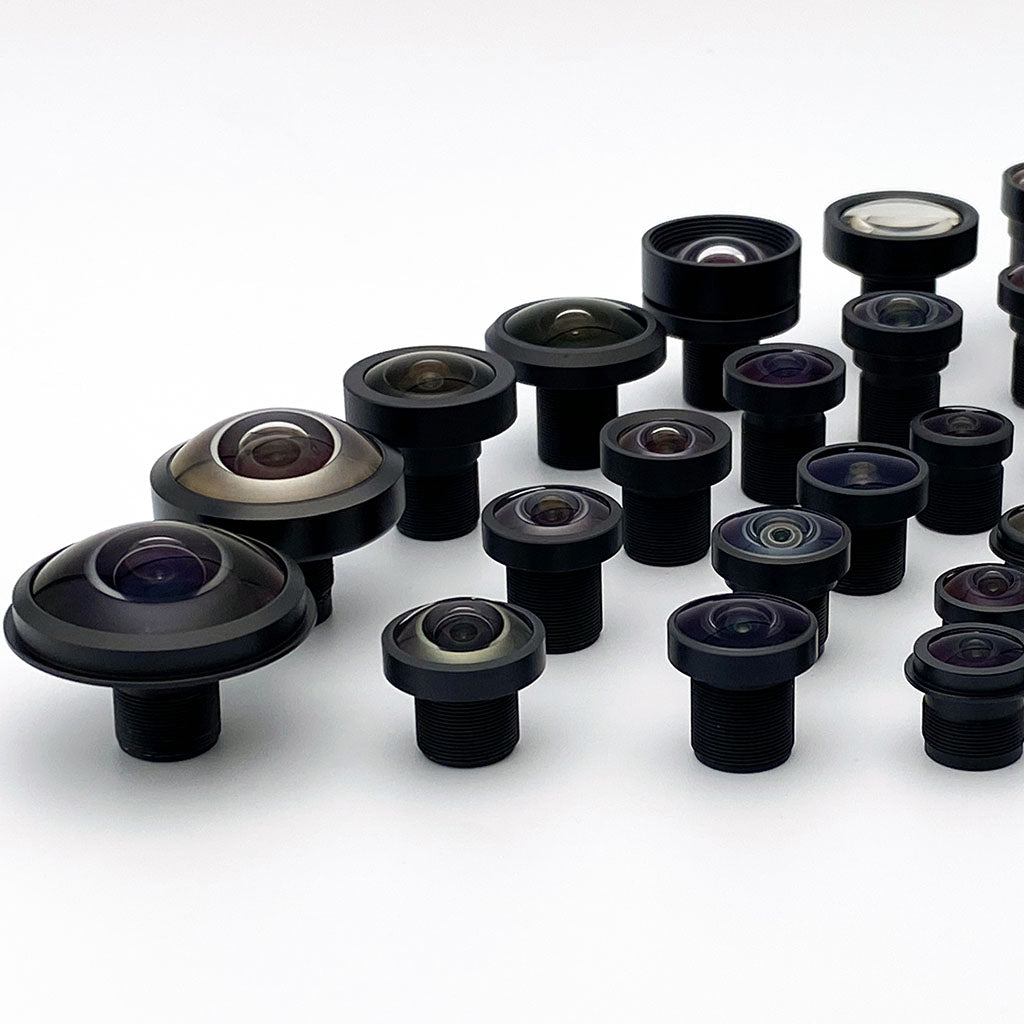

マシンビジョンにおける焦点距離の選び方:計算式、センサーサイズ、および選定手順
焦点距離は、それぞれの設定ごとに特定の答えがある幾何学的な問題です。このガイドでは、計算式、有効焦点距離が実際に何を意味するのか、選択手順の全容、そして望遠レンズが適している場合について解説します。

To choose a focal length for machine vision, start from three measured numbers: the scene width the camera must cover, the working distance from the front of the lens to the target, and the active width of your sensor. The required focal length is EFL = (WD × sensor_width) / FOV_width for rectilinear lenses, a far-conjugate approximation that holds closely at normal machine vision working distances, where the distance is long compared with the focal length.
注文する前に、最も近い標準焦点距離を選び、歪曲、被写界深度、イメージサークルを確認してください。画角計算ツールを使えば、あらゆるレンズとセンサーの組み合わせを数秒でチェックできます。
必要な焦点距離はどのように計算すればよいですか?
必要な焦点距離は、有効センサー幅に作動距離を乗じた値を、必要な被写体幅で割った値となります。 1/2.7インチセンサー(有効幅5.37mm)で、400mmの距離から幅120mmの部品を撮影する場合、必要な焦点距離は (5.37 × 400) / 120 = 17.9mm となります。したがって、実用的な高解像度標準レンズの候補としては、16mmと21.8mmが挙げられます。
This geometry is a far-conjugate approximation, exact only in a pinhole ray model. Real finite-conjugate imaging follows Gaussian conjugates measured from the principal planes, and the error grows with magnification. Covering a 100mm scene from 300mm with a 14.1mm-wide sensor (m ≈ 0.14), the formula gives 42.3mm, while the thin-lens form (Hecht, Optics, 5th ed., §5.2) f = WD × m / (1 + m) gives about 37mm. Fisheye and F-theta lenses use different projections. Use datasheet FOV values for those.

有効焦点距離とは何ですか?
Effective focal length (EFL) is the distance from a lens's rear principal plane to its focal point when the lens is focused at infinity. With the sensor size and the object and image conjugates, it sets field of view and magnification. The mm value printed on a lens listing (6mm, 12mm, 35mm) is the EFL. Nominal EFL does not change with working distance: a 12mm lens stays a 12mm lens at 500mm or 100mm. The effective value drifts slightly with focus breathing in internal-focus designs.
| 用語 | 概要 | 制御対象 |
|---|---|---|
| EFL(有効焦点距離) | 処方レンズの光学パラメータ | Field of view and magnification, with sensor and conjugates |
| BFL / MBFL(後焦点距離) | レンズごとの後方間隔寸法 | ホルダーとアダプターのクリアランス(レンズがピントを合わせられるかどうか) |
| FFD(フランジ焦点距離) | マウントの標準仕様 | レンズの交換性(17.526mm Cマウント、12.526mm CSマウント、M12は非対応) |
The EFL calculator runs the rectilinear math for common sensor formats and flags where the wide-angle caution applies.
マシンビジョン用レンズは、どのように段階を追って選定すればよいのでしょうか?
- 視野を定義します。ターゲット面におけるシーンの寸法をミリメートル単位で指定し、配置公差として10~20%の余裕を加えます。幅200mmの基板の場合、設計視野は240mmとなります。
- Measure the working distance. Working distance runs from the front of the lens to the target. Early in a project it is a design variable. Once the mechanical design commits, it hardens into a number you measure rather than choose. For M12 builds, the nearest reachable distance follows from the lens prescription, holder height and thread engagement, sensor-stack clearance, and the corner sharpness the task demands. Ask Commonlands engineering to confirm it. C-mount working distance varies by product, typically 100mm to infinity. The working distance guide covers this hardening.
- 有効センサーの寸法は、センサーのデータシートに記載されている「画素数×画素ピッチ」を参照してください。決して公称フォーマットの表記を鵜呑みにしないでください。イメージセンサーデータベースには、一般的な部品の有効領域が記載されています。
- Set the smallest feature to resolve. Divide scene width by horizontal pixel count for ground sampling distance (mm/pixel). Sensor Nyquist is a sampling ceiling, 1000/(2 × pixel_pitch_um) lp/mm, or two samples per line pair. Two pixels across the smallest feature is a separate inspection rule of thumb, and the headroom you need above it depends on contrast, the algorithm, and your inspection or decoder vendor's minimum sampling spec. The spatial resolution guide covers the math.
- 焦点距離を計算します。EFL = (WD × センサー幅) / FOV幅、その後、最も近い既製品値を絞り込みます。EFL計算ツールを使えば、この計算を一つのステップで完了できます。
- Choose the mount family. M12 fits compact, light, board-level builds. C-mount fits larger sensors and an adjustable iris. Its focus ring's internal mechanism and near-limit behavior vary by design, so verify both on the datasheet. CS-mount uses the same thread as C-mount with a shorter 12.526mm flange focal distance, compared with 17.526mm for C-mount. The lens mount guide compares thread, flange, and coverage in detail.
- Verify image quality. Run four checks: image circle at least as large as the sensor diagonal, distortion against the application's position-error budget, depth of field spanning the object height range (run the depth of field calculator), and lens MTF at the feature's spatial frequency (see the MTF curve guide).
焦点距離は、短め、中くらい、それとも長めを選ぶべきでしょうか?
Commonlands M12 lenses span all three focal length bands, and a medium range near 5mm to 16mm fits most factory inspection setups. Treat the bands as rough groupings, not hard thresholds. Shorter lenses tend to buy scene coverage and depth of field from close range. Longer lenses tend to buy pixel density at the cost of shallower depth of field. Distortion follows the lens projection and correction, not focal length alone. Start medium unless the geometry forces you elsewhere. The depth of field guide covers the long-lens trade.
| 焦点距離範囲 | 視野(相対) | Distortion (design-dependent) | 被写界深度 | 目標のピクセル密度 | 代表的な用途 |
|---|---|---|---|---|---|
| Short (<5mm) | ワイド | Design- and field-dependent | ディープ | 下へ | Wide coverage, navigation, autonomous mobile robots (AMRs) |
| 中(5~16mm) | 中程度 | Varies | 中程度 | 中程度 | 総合点検、バーコード読み取り |
| 長い(16mm超) | 狭い | Design- and field-dependent | 浅い | より高い | 微細構造の検出、計測学 |
The field of view column is relative, with no degree ranges, because the angle depends on the sensor as much as the lens: the same 12mm lens reads 25.2° on a 1/2.7" sensor and 33.3° on a 1/1.8" sensor. Compute the actual angle for your lens with the angle of view calculator before classifying a candidate as wide or narrow.
どのようなM12の焦点距離が、ほとんどの用途に対応できますか?
Three stock M12 lenses span the working range for most machine vision setups: 3.3mm for wide coverage, 6.2mm as the general-purpose default, and 12.5mm where pixel density matters. The full M12 catalog runs 0.8mm fisheye to 100mm telephoto.
Commonlands stocks M12 lenses in the US, with aperture and filter variants listed on each product page. Orders placed before 12 PM PST ship the same day from San Diego, CA.
Commonlands M12 lens options by focal length. Field-of-view angles are diagonal (DFOV) at each lens's stated reference circle, which can be smaller than its full image circle.
| レンズ | EFL | センサーフォーマット | FOV (diagonal) | 歪み | 価格 | こんな方に最適 |
|---|---|---|---|---|---|---|
| CIL036 | 3.3mm | 商品ページをご覧ください | 89° at the 6.4mm reference circle | -0.7% テレビ | $19 | 設置スペースが限られている場合でも、歪みの少ない広視野角を実現 |
| CIL062 | 6.2mm | 最大1/1.8インチ | 60° at 7.2mm reference circle (9.0mm full circle) | -2% rectilinear at 8.8mm | $19 | バランスの取れた総合点検と、デフォルトの出発点 |
| CIL125 | 12.5mm | 商品ページをご覧ください | 35° at 7.9mm reference circle | -1.4%(光学) | $39 | ピクセル密度を高め、フィールドを狭くすることで、細かい特徴やラベルを鮮明に捉える |
TV distortion is measured as the image-height deviation at the frame edge, rectilinear (optical) distortion against the paraxial ideal ray height, and F-theta distortion against the r = f·θ reference. Because the references differ, the percentages are not directly comparable row to row.
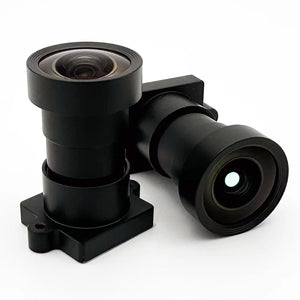
どのような場合に、マシンビジョン用の望遠レンズを選ぶべきでしょうか?
Choose a telephoto machine vision lens when the target is small or distant and the camera cannot move closer. As a rough guide, that means the target fills only a small fraction of the frame with the lens you have. Commonlands telephoto M12 options run 12.5mm to 50mm, with 75mm and 100mm models at the long end of the catalog. All of them trade scene coverage for magnification, tighter focus tolerance, and higher vibration sensitivity.
In machine vision, "telephoto" is used loosely for any long-EFL lens. Strictly it names a construction shorter than its focal length, so a long-focus lens is not necessarily telephoto (Smith, Modern Optical Engineering, 4th ed.). Doubling the EFL halves the linear field of view at the same working distance and doubles the apparent target size. Typical applications are aerial inspection from drones, traffic monitoring at distance, overhead conveyor lines, and barcode or OCR reading at long standoff.
Long lenses are less forgiving than short ones. Depth of field shrinks rapidly as focal length grows, so a focus setting easy at 6mm becomes critical at 35mm, and image shift from platform wobble scales with focal length. Plan stiffer mounts, lock focus, and re-verify after mechanical service. The focusing guide covers the procedure.
Telephoto is also often the wrong answer: to monitor a wide area or run on a vibration-heavy platform, a shorter focal length tolerates the pointing error and motion that would push a narrow frame off target.
Near-focus behavior differs by mount. A C-mount telephoto focuses by ring rotation. The ring may drive the whole cell, a front group, or a cam, and near-stop sharpness is design-specific, so confirm minimum object distance with Commonlands engineering. M12 telephotos are rigid barrels focused by thread rotation: thread engagement, the barrel shoulder, and rear-element clearance set hard near-focus limits, so short standoffs demand deep holders, and close-range sharpness falls to conjugate-dependent aberrations such as field curvature, not center focus alone.
Selected telephoto M12 lenses reach 1/1.7" sensor coverage in a fixed-aperture board-lens package, the right fit for drones, embedded systems, and weight-limited payloads. Move to C-mount when the sensor is larger, when you need an iris to stop down for depth of field, or when lighting is too dim to fix at a fixed aperture. The low-light section of the f-number guide covers that trade.
Commonlands telephoto M12 lenses from 12.5mm to 50mm, ordered by focal length.
| パート | EFL | 書式 | 決議 | 絞り | 価格 |
|---|---|---|---|---|---|
| CIL125 | 12.5mm | 最大1/2インチ | 12MP | 修正済み | $39 |
| CIL121 | 21.8mm | 最大 1/1.7インチ | 12MP以上 | 修正済み | $70 |
| CIL350 | 35mm | 1/1.7インチ | 8~10メガピクセル | 修正済み | $59 |
| CIL051 | 50mm | 最大1/1.8インチ | 12MP | 修正済み | $79 |
The resolution column names the sensor class each design targets. MP ratings are unstandardized labels with no aperture, field, spectrum, or contrast conditions attached. Confirm against the measured MTF data and pixel-pitch pairing on each product page.
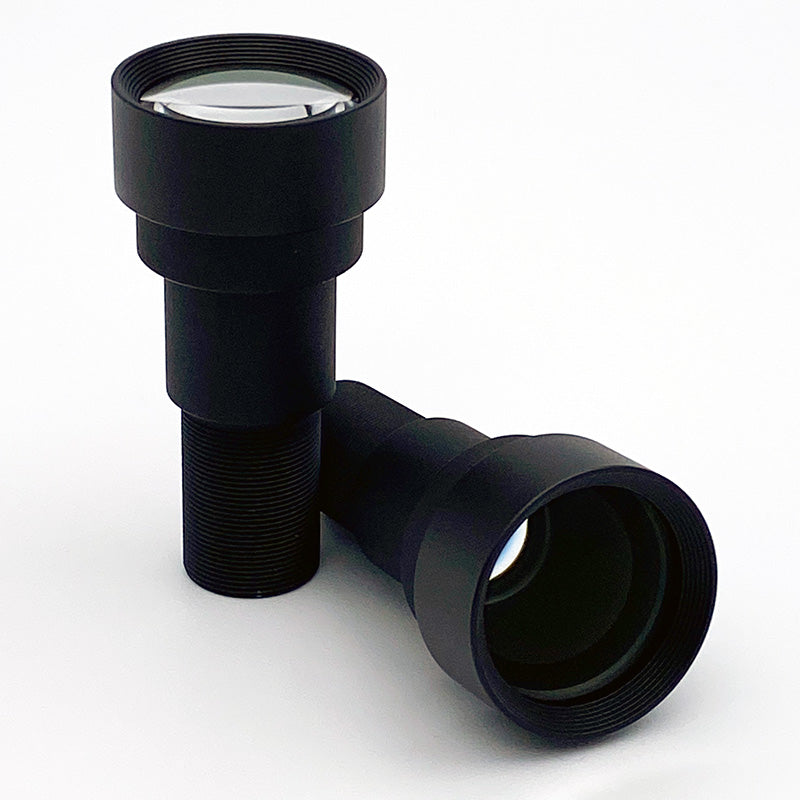
計算された焦点距離が存在しない場合はどうなるのでしょうか?
Round to the nearest stock focal length and recompute the field of view. Rounding shorter gives extra coverage you can crop, the safe default when installation geometry is not locked. Rounding longer gives less coverage and is only acceptable once you confirm the scene still fits the sensor, the call when the feature is small and resolution outweighs coverage. If neither works, a 10–20% working distance change is a starting point we use, provided magnification, clearance, perspective, and lighting allow.
Commonlands stocks M12 focal lengths in discrete steps (2.6mm, 3.3mm, 3.6mm, 6.2mm, 8mm, 12.5mm, 14.2mm, 16mm, 18mm, 19mm, 21.8mm, 25mm, and up), so a calculated value will often land between them. The steps cluster tightly from 12mm to 25mm, where the nearest option usually sits within about 10% of the calculated value. Some intermediate steps, including the 18mm and 19mm options, are lower-resolution designs rated for 2MP sensors and below, so check the resolution rating before shortlisting.
Whatever the rounding decision, validate with physical test images before locking the design: mount the lens at the planned distance, image a calibration target or the real part, and confirm the features resolve and the scene fits. Test images catch corner vignetting, focus error at the target plane, and distortion in the actual part geometry that the math does not.

よくある質問
The Commonlands FOV calculator runs these formulas for any sensor. The answers below explain the math behind it.
視野と作動距離から焦点距離をどのように計算すればよいですか?
有効センサー幅に作動距離を掛け、必要な被写体幅で割ります:EFL = (WD × センサー幅) / FOV_width。作動距離400mmで120mmの被写体をカバーする1/2.7インチセンサー(有効幅5.37mm)の場合、必要な値は (5.37 × 400) / 120 = 17.9mmとなります。 したがって、16mmと21.8mmが高解像度の標準候補となります(18mmおよび19mmのオプションは、2MP以下のセンサー向け低解像度設計として存在します)。EFL計算ツールでは、この計算を直接実行できます。
有効焦点距離とは何ですか?
Effective focal length (EFL) is the distance from a lens's rear principal plane to its focal point when the lens is focused at infinity. With the sensor size and the object and image conjugates, it sets field of view and magnification. The mm value on a machine vision lens listing (6mm, 12mm, 35mm) is the EFL, not the back focal length and not the flange focal distance.
マシンビジョン用レンズの選定には、どのような手順があるのでしょうか?
Machine vision lens selection runs in a fixed order: define the required field of view, measure the working distance, and pull active sensor dimensions from the sensor datasheet. Then set the smallest feature to resolve, calculate focal length with EFL = (WD × sensor_width) / FOV_width, and choose the mount family. The final step is to verify image circle, distortion, depth of field, and MTF.
マシンビジョン用望遠レンズとは何ですか?
望遠マシンビジョンレンズは、長い焦点距離を持つ設計となっており、所定の作動距離において狭い視野と高い倍率を実現します。一般的なM12規格の望遠レンズは12.5mmから50mmの範囲があり、小型または遠方の被写体(航空検査、交通監視、長距離バーコード読み取りなど)を撮影できますが、その代償として、焦点精度や振動許容度にはより厳しい要件が求められます。
もし自分に最適な焦点距離が存在しなかったら、どうなるのでしょうか?
Choose the nearest stock focal length and recompute the field of view. Rounding shorter adds coverage you can crop in software, which is the safer direction. Rounding longer cuts coverage and requires confirming the scene still fits the sensor. A 10–20% working distance change is a starting point we use when magnification, clearance, perspective, and lighting allow. Verify any candidate with the field of view calculator before ordering.
推奨焦点距離を確認する
Send your working distance, scene size, and sensor part number to the Commonlands engineering team in San Diego and they will run the numbers with you. Orders placed before 12 PM PST ship the same day.