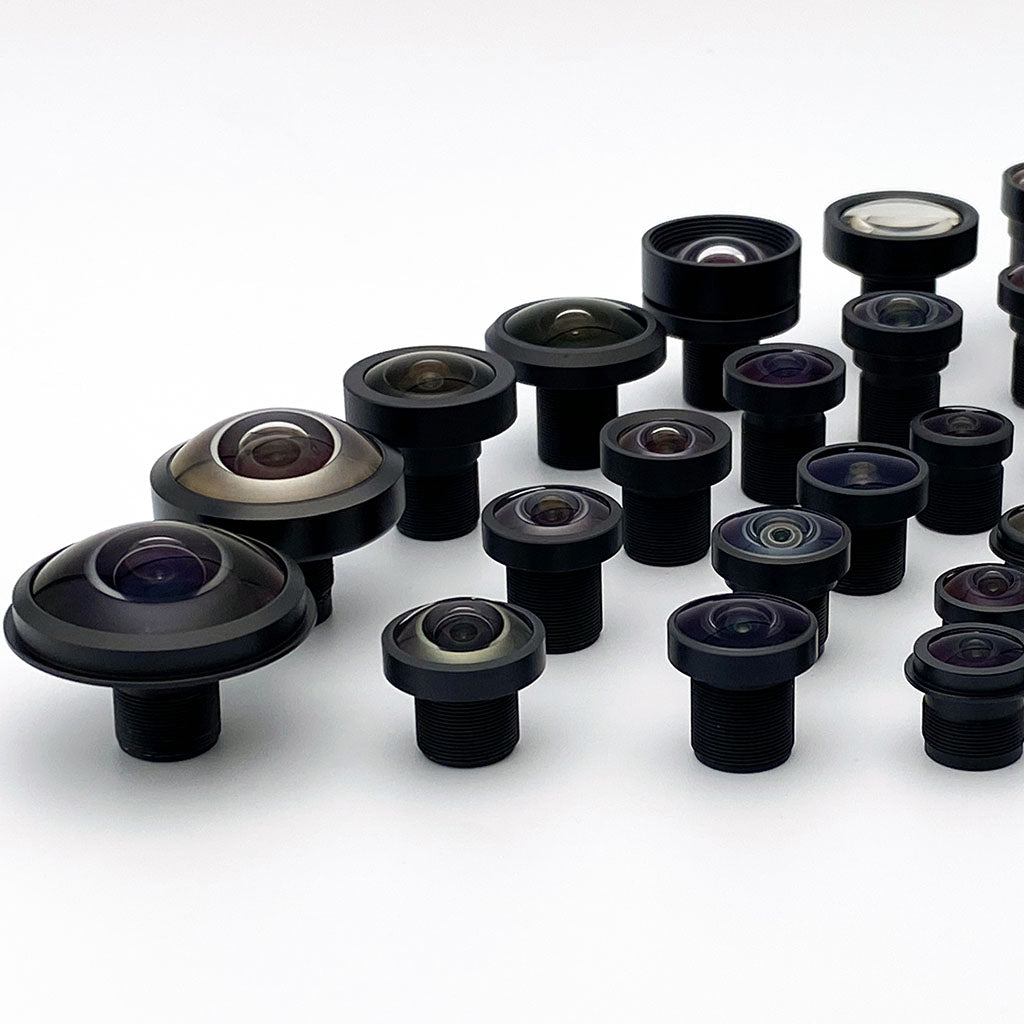

マシンビジョンにおける空間分解能:1ピクセルあたりのmm、最小検出サイズ、および回折限界
Field of view, pixel count, lens resolving power, and aperture combine to set the smallest feature a camera system can detect.

Spatial resolution is the real-world size one pixel samples at the working distance: the sampling interval, not the smallest feature the system can resolve. Divide the field of view by the pixel count across it: a 100mm wide FOV on 2592 horizontal pixels gives 0.039mm per pixel. The sampling needed for detection or measurement depends on feature contrast, blur, noise, sampling phase, and the algorithm. Establish it with representative targets and an acceptance test.
Pixel math sets the ceiling, not the result. Sensor Nyquist, lp/mm = 1 ÷ (2 × pixel pitch in mm), is a sampling reference rather than a universal lens requirement. Evaluate MTF at the frequencies the task needs. Diffraction reduces contrast gradually as aperture narrows, without a sudden threshold when the Airy disk reaches two pixels. This guide covers all four layers: pixel math, angular sampling (IFOV), lens resolving power, and diffraction.
What Is Spatial Resolution in Machine Vision?
Spatial resolution is the real-world size one pixel samples at the working distance, written as mm per pixel: a sampling interval (strictly, the object-space sampling distance. Ground sample distance in remote sensing), not the smallest feature the system resolves. Two numbers set it: field of view and pixel count along that axis. A 12MP camera (4032 × 3024) on a 600mm wide tote has 0.149mm per pixel. On a 60mm connector it has 0.0149mm per pixel, ten times finer. Only the field of view changed.
If one pixel covers 0.1mm, a 0.05mm scratch is sub-pixel and usually lost unless its contrast is high. A 0.4mm scratch spans four pixels and is detectable. Its distance-independent counterpart is the per-pixel angle, covered in the IFOV section. A megapixel count is only a pixel budget, so this guide also covers resolving power and diffraction, with Commonlands M12 and C-mount examples.

How Do You Calculate mm per Pixel?
Divide the field of view by the pixel count along the same axis. A 100mm wide scene on 2592 horizontal pixels gives 0.0386mm per pixel. The reciprocal is pixels per mm.
Use mm per pixel for inspection sizing. Lens resolving power is quoted in lp/mm at the image plane, a different plane from object-space pixels per mm: divide an object-space frequency by the magnification to compare, or work in image space, where one line pair needs two pixels (lp/mm = 1 ÷ (2 × pixel pitch in mm)). Model any sensor, focal length, and working distance with the Commonlands FOV calculator. With noticeable distortion, the average does not hold at the frame edges.
What Is the Minimum Detectable Size in Machine Vision?
Minimum detectable size is the smallest feature a system reliably identifies. Multiply spatial resolution by the pixel coverage the task needs: minimum size = (FOV ÷ pixel count) × required pixels. Two pixels is the theoretical sampling floor, a Nyquist figure for periodic patterns that noise or blur erases. A high-contrast sub-pixel particle can still be detected, but not sized. Production inspection typically needs 3 to 5 pixels across a defect, and measurement 10 or more. Both are starting heuristics moved by contrast, SNR, and algorithm.
| タスク | 機能全体にわたるピクセル | 注記 |
|---|---|---|
| 理論上のサンプリング下限 | 2 | Depends on sub-pixel alignment and near-perfect contrast. Not a design point |
| コントラストの高い「あり/なし」表示 | 3~5 | 制御された照明条件下で、明るい背景上の暗いひび割れを撮影するための有効な露出マージン |
| 形状または方位の分類 | 5~10 | 円形の特徴と細長い特徴を区別するのに十分な詳細 |
| コントラストの低い欠陥や、テクスチャのある欠陥 | 8~15 | より多くのピクセルが、ノイズフロアを上回る十分な信号を蓄積する |
| 寸法測定 | 10+ | サブピクセルアルゴリズムは、解像度の高い境界線に限り、約0.1~0.3ピクセルまで精細化します。 |
Target: detect a 0.2mm scratch with 5 pixels of coverage. Required spatial resolution = 0.2 ÷ 5 = 0.04 mm/pixel. On a 2448-pixel-wide sensor, the maximum horizontal FOV = 0.04 × 2448 = 98mm. Find the focal length that produces a 98mm FOV at your working distance.
Motion Blur Eats the Pixel Budget
A part moving at velocity v during exposure t smears the image by v × t. Keeping that smear under half a pixel at your spatial resolution is a common heuristic. Past it, features near the minimum detectable size start disappearing.
What Is IFOV in Machine Vision?
Instantaneous field of view (IFOV) is the angle a single pixel subtends. It is a sampling quantity, not optical angular resolution: separating two points is a Rayleigh or MTF question, and a system can sample finer than its optics resolve. IFOV = FOV ÷ pixel count gives the frame average, since the per-pixel value varies with field position. An 80° FOV across 3840 pixels averages 0.021° per pixel, or 48 pixels per degree. Multiplied by the working distance, that becomes the pixel footprint on the object.
| レンズ | FOV (axis named) | IFOV on a 4K frame | 1度あたりのピクセル数 |
|---|---|---|---|
| CIL250 25mm 望遠 M12 | 20° diagonal at 8.8mm reference circle. 9.4mm full image circle covers 1/1.7" | 0.0045° (diagonal) | ~220 (diagonal) |
At fixed sensor resolution, wide coverage and fine angular sampling are in tension. Because real-world contrast, noise, and blur are worse than on the bench, many teams carry a 2× to 3× design margin over the theoretical minimum pixel count. The factor depends on MTF, task contrast, sensor noise, and the detector or decoder's minimum-sampling spec.
What Does a Megapixel Rating Mean on a Machine Vision Lens?
レンズのメガピクセル表示は、そのレンズが対応するように設計されたセンサーのクラス(ピクセルピッチとフォーマット)を示すものであり、光学分解能を示すものではありません。分解能は、像面における1ミリメートルあたりのラインペア数(lp/mm)で測定され、ナイキストの法則によってその要件が定められています:lp/mm = 1 ÷ (2 × ピクセルピッチ [mm])。
| ピクセルピッチ | 必要な lp/mm(ナイキスト) | センサーの例 |
|---|---|---|
| 5.0µmクラス | 100 lp/mm | 高画素のグローバルシャッターセンサー |
| 3.45µm | 145 lp/mm | ソニー Pregius IMX250、IMX264(5MP)、IMX253、IMX304(12MP) |
| 2.74µm | 182 lp/mm | ソニー・プレギウス S IMX547(5.1MP)、IMX546(8.1MP)、IMX541(20.4MP) |
| 2.0µm | 250 lp/mm | Sony IMX678(8MP、1/1.8インチ)および同等の組み込み型センサー |
| 1.55µm | 323 lp/mm | 高密度組み込み型およびスマートフォンクラスのセンサー |
Coverage is the second requirement: the lens image circle must be at least the sensor diagonal, or the corners vignette. The MTF check evaluates contrast near 0.5 to 0.7× the Nyquist frequency the pixel pitch sets, a Commonlands starting band rather than a standard (validate against your task), held out to the corners. Nyquist itself is a sampling ceiling, not an MTF target. A cutoff above it does not guarantee contrast holds that far. If either check fails, the lens limits the system regardless of megapixel labels.
What Is the Diffraction Limit in Machine Vision?
The diffraction limit is the minimum blur spot a lens can produce at a given aperture, set by the wave nature of light, not manufacturing quality. Stopping down shrinks aberrations but grows the Airy disk linearly with F#, so a smaller aperture eventually caps resolution.
The MTF of a diffraction-limited lens falls to zero at a cutoff frequency of 1 ÷ (λ × F#). At 550nm and F/8, that cutoff is roughly 227 lp/mm. At F/16, still at 550nm, it drops to 114 lp/mm, below the 145 lp/mm a 3.45µm sensor needs. "Diffraction-limited" is not a defect label: the lens is corrected well enough that diffraction, not residual aberration, decides image quality at that aperture.
What Is an Airy Disk?
The Airy disk is the bright central spot of the diffraction pattern from a point source imaged through a circular aperture. The first dark ring bounds it. About 84% of the pattern's energy falls inside (Hecht, Optics, 5th ed.). No lens can focus light to a smaller spot at that aperture and wavelength.
| F# | 550nmにおけるエアリーディスク | 3.45µmピクセルあたりのスパン | 2.74µmピクセルあたりのスパン | 1.55µmピクセルあたりのスパン |
|---|---|---|---|---|
| F/1.9 | 2.5µm | 0.7ピクセル | 0.9ピクセル | 1.6 ピクセル |
| F/2.8 | 3.8µm | 1.1 ピクセル | 1.4 ピクセル | 2.4 ピクセル |
| F/4 | 5.4µm | 1.6 ピクセル | 2.0 ピクセル | 3.5ピクセル |
| F/5.6 | 7.5µm | 2.2ピクセル | 2.7ピクセル | 4.8 ピクセル |
| F/8 | 10.7µm | 3.1 ピクセル | 3.9 ピクセル | 6.9 ピクセル |
| F/11 | 14.8µm | 4.3 ピクセル | 5.4 ピクセル | 9.5ピクセル |
| F/16 | 21.5µm | 6.2 ピクセル | 7.8 ピクセル | 13.9 ピクセル |
Wavelength scales the disk linearly. At 850nm the Airy disk is about 55% larger than at 550nm for the same F#, so NIR systems hit diffraction at wider apertures than visible-light systems. See the NIR imaging guide for wavelength-specific notes.
Pixel-Pitch Matching: When the Sensor Out-Resolves the Lens
Compare the Airy disk to twice the pixel pitch as a marker, not a cliff: diffraction contrast falls off gradually, so useful detail survives past it. At 550nm and far conjugates, that marker lands near F/5.1 for 3.45µm pixels, F/4.1 for 2.74µm pixels, and F/2.3 for 1.55µm pixels. Close in, substitute the working f-number.
A 2.74µm sensor samples more finely than a 3.45µm sensor. Diffraction does not erase that benefit at a particular Airy-disk-to-pixel ratio. Compare the combined optical and sampling response, noise, and task result at the intended aperture.
Opening from F/11 to F/5.6 admits roughly 4× the light and halves the Airy disk. Brighter or strobed light buys back the exposure lost to a stopped-down aperture. Deconvolution can partially restore diffraction-attenuated contrast, at a noise cost. Nothing recovers detail past the cutoff. Pick the aperture from the depth of field your scene needs with the depth of field calculator, then check the Airy disk against twice the pixel pitch and the MTF there. The Commonlands f-number guide covers the full tradeoff.
Lens Examples Across the Resolution Range
These Commonlands lenses are a shortlist for each resolution tier. Here, supported means the published MTF holds at the sensor Nyquist band under the conditions on each product page.
Lens Picks by Resolution Requirement
| 解像度レベル | おすすめのレンズ | マウント | F# | 対応する最小ピクセルピッチ | 注記 |
|---|---|---|---|---|---|
| 1~2MPのエントランス検査 | CIL028 2.6mm | M12 | 商品ページをご覧ください | 1~2MPでは決定的な制約ではない | Covers up to 6MP at 2.2µm. Pick the lowest-cost lens that covers your format. |
| 5MP 汎用 | CIL059 5.9mm | M12 | F/1.7~F/5.6 | 商品ページをご覧ください | Fixed-aperture M12 variants chosen at purchase. The F/1.7 build is rated 4–6MP. The F/4.0 build reaches 12MP as residual aberrations drop. |
| 8~12MPの検査 | CIL160 16mm | M12 | F/1.9~F/5.6 | 商品ページをご覧ください | F/2.8~F/4.0で12MPの解像度を持つ固定絞りモデル。F/5.6のモデルでは、回折の影響が強まるため、解像度が8MPに低下する。 |
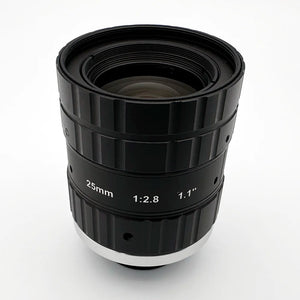
| 8~12MPの計測 | CIL514 25mm | Cマウント | F/2.8~F/16 | 3.45µm | Adjustable iris. The Airy disk reaches two pixel pitches near F/5.1 at 550nm. |
| 8~12MP ファインピッチ | CIL535 35mm | Cマウント | F/2.0~F/16 | 2.2µm | Adjustable iris, rated for 2.2µm pixels at 12MP. At 550nm the Airy diameter reaches two 2.2µm pixel pitches near F/3.3. This is a comparison scale, not an aperture limit. Test whether stopping down improves the required depth of field while retaining enough task contrast. |
Above 12MP on formats larger than about 1.1 inch, fixed-focal C-mount FA lenses from Kowa, Fujinon, and Moritex are the established choices. The Commonlands M12 and C-mount optics above target the 1/4" to 1.1" formats. Size the field of view for any pick in the FOV calculator.
焦点距離の制御:視野(FOV)と1ピクセルあたりのmm数を設定します
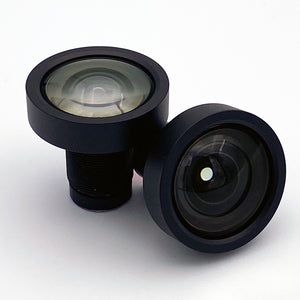
絞り制御:回折によるトレードオフの管理
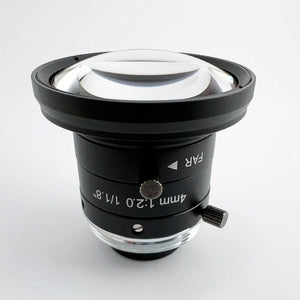
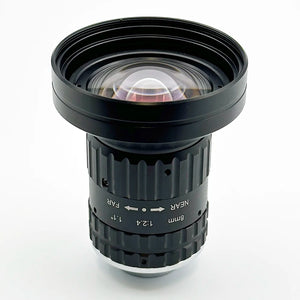
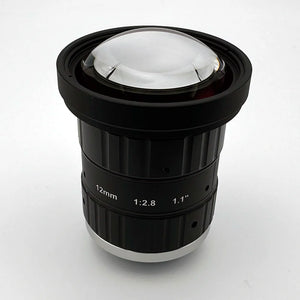

Technical references
よくある質問
マシンビジョンにおける空間分解能とは何ですか?
Spatial resolution is the real-world size one pixel samples at the working distance, expressed in mm per pixel. Divide the field of view by the pixel count across it: a 100mm FOV on 2592 horizontal pixels gives 0.039mm per pixel. That is the sampling interval, not the smallest detectable feature: reliable detection needs a feature to span several pixels, typically 3 to 5.
マシンビジョンにおける検出可能な最小サイズはどれくらいですか?
最小検出サイズは、ビジョンシステムが確実に識別できる最小の形状を指します。空間分解能に、その形状を検出するために必要な画素数を掛け合わせます:(視野角 ÷ 画素数)× 必要な画素数。2048画素で視野角が100mmの場合、1画素あたりのサイズは0.049mmとなるため、5画素の検出対象となると、0.24mm以上の形状が検出可能となります。
カメラにおけるIFOVとは何ですか?
IFOV (instantaneous field of view) is the angle subtended by one pixel. IFOV = FOV ÷ pixel count gives the average across the frame. The per-pixel value varies with field position. A camera with an 80° horizontal FOV and 3840 pixels averages about 0.021° per pixel, or 48 pixels per degree. Near the axis on a perpendicular plane, pixel footprint is approximately distance multiplied by local IFOV in radians. Off axis, use the projection geometry. For a planar rectilinear view, the radial scale includes a sec²(θ) factor.
マシンビジョン用レンズにおいて、「メガピクセル」とはどのような意味を持つのでしょうか?
A megapixel rating describes the sensor class a lens is designed to cover, a combination of pixel pitch and format, not its optical resolving power. Resolving power is measured in lp/mm. Two lenses with different megapixel labels can resolve identically in lp/mm. The higher label often just reflects a larger image circle for a bigger sensor at the same pixel pitch.
マシンビジョンにおける回折限界とは何ですか?
回折限界とは、光の波動性によって決まる、特定の絞り値においてレンズが作り出すことのできる最小のぼやけた像のことであり、F/8、波長550nmの条件下では、回折限界に達したレンズの解像度はおよそ227 lp/mmを超えることはできず、そのエアリー円盤の直径は10.7µmとなり、これは3.45µmのセンサー上で3ピクセル以上に相当する。
Match a Lens to Your Resolution Requirement
Send us the defect size, working distance, and sensor. The Commonlands engineering team will work through the FOV, pixel coverage, lp/mm, and aperture numbers with you, or you can run the math yourself first.