
MTF Testing Services | Trioptics HR2 Lens Testing | Commonlands
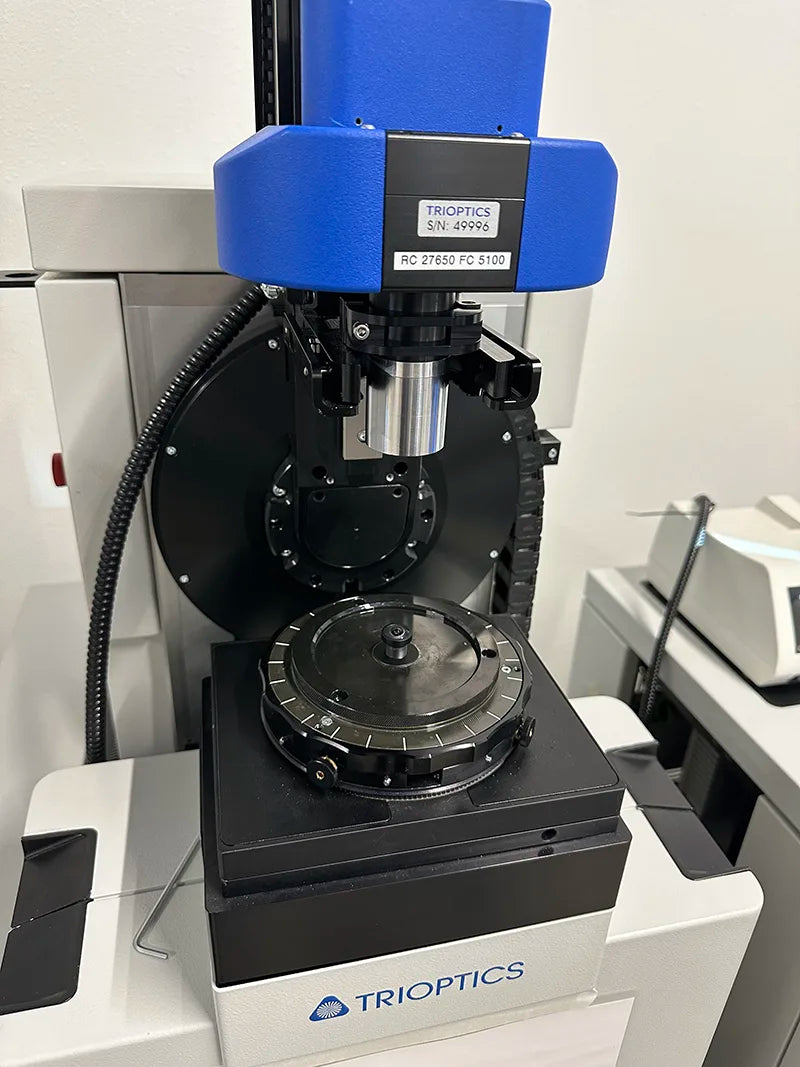
Trioptics ImageMaster HR2 MTF testing at Commonlands

MTF Testing Services

Lens characterization using a Trioptics ImageMaster HR2. The standard report includes MTF vs field, MTF vs spatial frequency, EFL, distortion, chromatic aberration, astigmatism, and field curvature. MTF is traceable to PTB; EFL is traceable to NIST.

$199.00

Per lens, Commonlands lenses. Third-party lenses quoted separately.

Contact Engineering
📋 PTB & NIST Traceable

Standard Report Parameters

Measured at infinity conjugate with photopic spectral weighting (400–700nm)

パラメータ Method
有効焦点距離 On-axis and vs field position. NIST traceable.
MTF Through Focus On-axis MTF measured through focal range to determine best focus and depth of focus.
MTF vs Field 9 field positions along 3 azimuths (0°, 45°, 90°). Reports both tangential (MTFT) and sagittal (MTFS).
MTF vs Spatial Frequency Contrast transfer reported at multiple spatial frequencies in lp/mm.
ディストーション 21 field points along one axis. Reported as percentage.
倍率色収差 Measured at 480nm (F'), 546nm (e), and 644nm (C'). Reports transverse color shift vs field.
縦色収差 Focus shift between 480nm, 546nm, and 644nm.
乱視 Derived from MTFT vs MTFS difference across field. Surface map provided.
フィールドの曲率 Best focus position vs field height for tangential and sagittal focal surfaces.

Custom Testing

Additional measurements available on request

Extended Field Mapping

Higher density field point coverage for uniformity analysis across the full image circle.

NIR Wavelengths

MTF measurement at 850nm or 940nm for sensing and night vision applications.

Finite Conjugate

Testing at specified object distances for lenses not optimized for infinity.

Additional Parameters

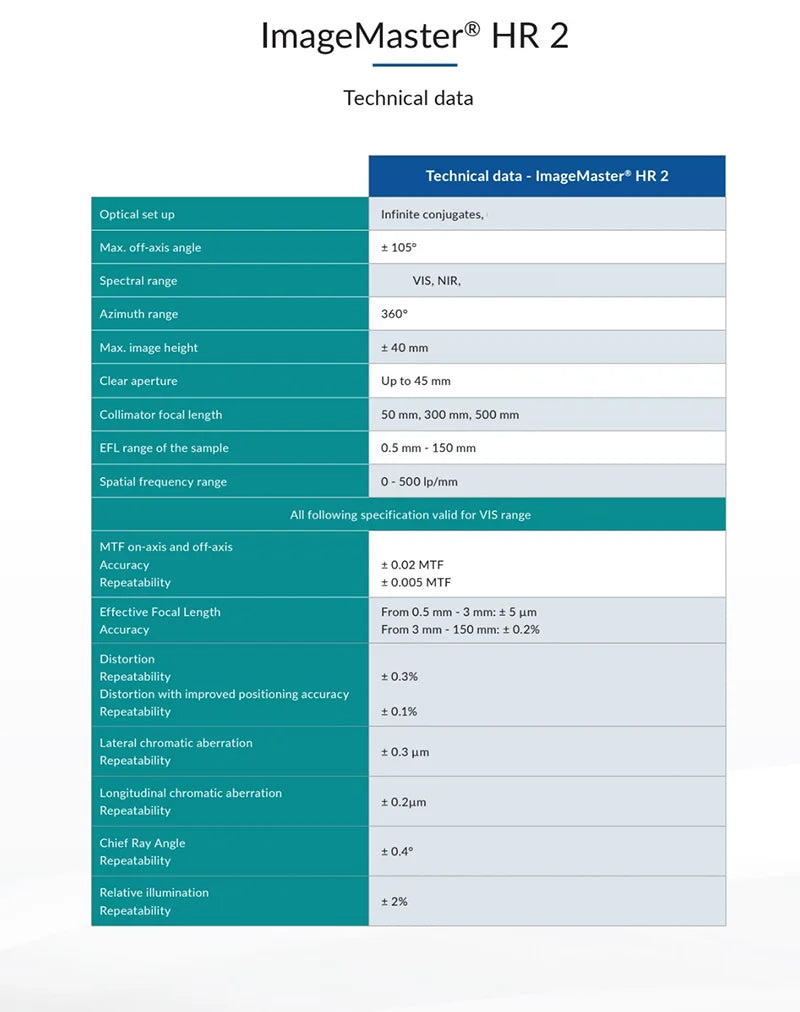
Relative illumination, chief ray angle, F-number, veiling glare, PSF, encircled energy.

テクニカルFAQ

MTF (Modulation Transfer Function) quantifies a lens's ability to transfer contrast from object to image as a function of spatial frequency. It is measured by imaging a slit or edge target through the lens and analyzing the resulting intensity distribution. The Fourier transform of the line spread function yields MTF. Values range from 0 to 1, where 1 represents perfect contrast transfer at that spatial frequency. MTF decreases at higher spatial frequencies due to diffraction and aberrations.

MTFT (tangential) and MTFS (sagittal) measure contrast transfer for orthogonal orientations of the line spread function relative to a radial line from the optical axis. MTFT responds to radially-oriented features; MTFS responds to tangentially-oriented features. At off-axis field positions, astigmatism causes these two focal surfaces to separate, resulting in different MTF values for each orientation. The magnitude of the MTFT/MTFS difference indicates astigmatism severity.

Traceability to PTB (Physikalisch-Technische Bundesanstalt, Germany's national metrology institute) means the MTF measurement can be related to international standards through an unbroken chain of comparisons, each with stated uncertainties. This ensures measurements made on our equipment correlate with measurements made on other calibrated instruments worldwide. EFL traceability to NIST provides the same assurance for focal length measurements.

These wavelengths correspond to standard spectral lines used in optical design: 480nm approximates F' (blue), 546nm is the mercury e-line (green), and 644nm approximates C' (red). Measuring at these three wavelengths characterizes both lateral color (transverse chromatic aberration causing color fringing) and longitudinal color (axial chromatic aberration causing wavelength-dependent focus shift).

Yes. Testing lenses not manufactured by Commonlands requires custom fixturing and setup time, so pricing is higher than the standard rate. Contact engineering with your lens specifications: focal length, f-number, mount type (M12, C-mount, etc.), image circle diameter, and mechanical back focal distance. We will provide a quote and lead time.

Order MTF Testing

Standard reports for Commonlands lenses are typically delivered within 5 business days.

Contact Engineering