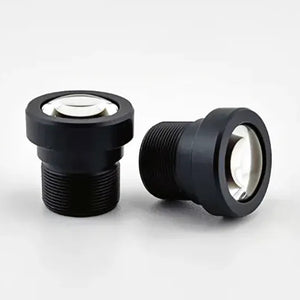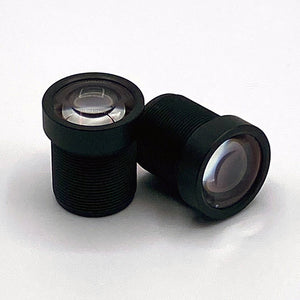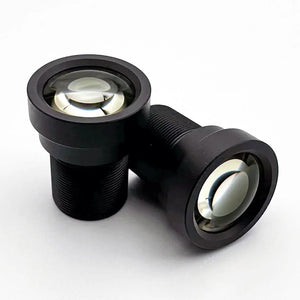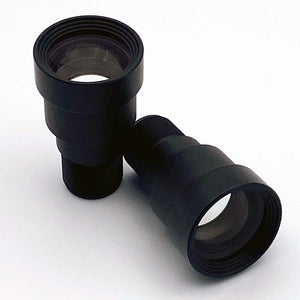

Machine Vision Lenses for Transportation

Lenses for Intelligent Transportation Systems: Focal Length, Iris Control, and Plate-Pixel Requirements

Focal length, iris control, and pixel density for traffic monitoring, LPR/ANPR, speed cameras, smart-city intersections, and tolling.

By the Commonlands engineering team · Updated July 2026 · 19 min read

A traffic camera in a weatherproof housing with a telephoto C-mount lens over a highway

Intelligent transportation systems (ITS) span traffic monitoring, license plate recognition, speed enforcement, smart-city intersections, and tolling. These are outdoor, finite-working-distance imaging problems, typically 10 to 20 meters from camera to target. Most deployments use a C-mount lens in the 12mm to 75mm range because the job needs telephoto reach, adjustable iris control for a wide outdoor dynamic range, and compatibility with high-resolution sensors.

Focal length is derived from mounting distance, required scene width, and sensor format using EFL = (sensor dimension × working distance) / field dimension, not guessed. For license plate reads specifically, the lens also has to deliver enough pixels per character, and it must be paired with the right shutter speed and NIR illumination. Telephoto alone cannot fix motion blur or contrast.

What does an ITS camera need from a lens?

An ITS lens has to deliver enough resolution at a fixed, known distance, hold focus across a wide temperature swing, and manage a dynamic range that runs from headlight glare to pre-dawn darkness. Traffic monitoring, LPR/ANPR, speed enforcement, and tolling all share this same finite-working-distance geometry, which is what separates ITS optics from general outdoor surveillance covered on the lenses for surveillance page.

Finite working distance, not infinity focus

A roadside, gantry, or bridge-mounted ITS camera is targeting a scene at a defined distance, typically 10 to 20 meters in close-proximity deployments and further for highway ANPR or tolling gantries. The lens has to be set to that focus distance, and the depth of field must span the expected range of vehicle positions within the lane. That is a different design problem than a security camera focused near infinity.

Telephoto reach for target isolation

Even a moderate 15 to 20 meter working distance needs more focal length than a typical embedded machine vision application. At those distances a 12mm lens on a 2/3" sensor gives a wide enough field of view to capture multiple lanes but may not provide enough target magnification to resolve fine detail. Longer focal lengths isolate the target lane more tightly and put more pixels on each vehicle, which improves classifier and OCR performance. See how to choose focal length for machine vision for the underlying selection method.

Outdoor dynamic range

ITS cameras run from pre-dawn darkness to midday sun, often within the same 24-hour cycle: on the order of 15+ stops of scene illumination change, far more than any iris alone can absorb. Iris, shutter, and sensor gain have to share that range: an adjustable iris (roughly 6 stops from F/1.4 to F/11) lets the system operate near F/1.4 in low light and stop down to F/8 or F/11 in bright conditions, but exposure time and gain still have to cover the rest.

Mechanical and environmental stability

Roadside mounts vibrate, and outdoor enclosures see temperature cycles that shift lens focus. Rain, dust, and thermal expansion affect image quality over the life of a deployment. These factors are independent of the optical formula but determine which lenses can be run reliably in an ITS context; see the outdoor tradeoffs section below.

A telephoto C-mount lens with a manual iris ring standing on a gray surface
A long focal length resolves license plates at highway distance.

How lens requirements differ across ITS applications

Traffic monitoring, LPR/ANPR, speed enforcement, smart-city intersection cameras, and tolling gantries share the same finite-working-distance geometry, but each application weights the lens requirements differently. Sizing a lens without accounting for these differences can lead to field underperformance even when the raw focal-length math checks out.

Traffic monitoring and lane occupancy

General traffic monitoring (counting vehicles, detecting lane occupancy, and flagging stopped vehicles or wrong-way movement) tolerates a wider field of view and lower per-vehicle pixel density than plate reading. A 12mm to 25mm C-mount lens on a 2/3" sensor typically covers one to two lanes at 10 to 20 meters with enough resolution for vehicle detection and classification, without needing the telephoto reach that OCR-grade LPR demands.

Speed enforcement cameras

Speed cameras add a timing or radar/LIDAR component to the imaging problem, but the lens still has to deliver a sharp, correctly exposed frame at the decision moment. Because speed enforcement often needs to resolve a plate for citation purposes at the same time it captures vehicle position, the lens selection typically follows the same pixel-per-character requirement as LPR, sized for the specific trigger distance rather than a full lane's working-distance range. Shutter speed is especially critical here: a vehicle at highway speed has to be frozen sharply enough that the plate is legible at the exact trigger frame, not just in general.

Smart-city intersection cameras

Intersection cameras for adaptive signal control, pedestrian detection, and multi-modal traffic analytics usually prioritize wide field of view over long reach, because the camera needs to see the full intersection footprint rather than isolate a single distant target. A shorter focal length, often 4mm to 12mm C-mount, is common here, with the tradeoff that per-vehicle pixel density drops toward the edges of the frame. Multiple cameras per intersection, each covering one approach, is a common way to keep focal length short while still resolving detail on each approach lane.

Tolling gantries

Tolling applications combine LPR-grade plate reading with the added constraint of a gantry mount that may be angled relative to the lane, and frequently need to distinguish vehicle class (car, truck, motorcycle) alongside the plate read. Working distances at tolling gantries commonly run longer than roadside pole mounts, which pushes focal length selection toward the 50mm to 75mm C-mount range and makes adjustable iris and depth-of-field control more important, since vehicle height varies enough to shift the effective plate distance within a single lane.

Why is C-mount the standard format for ITS cameras?

C-mount is the standard ITS format because it covers the focal-length range the job requires (4mm to 75mm and beyond), provides an adjustable iris ring for dynamic-range control, and uses the 1"-32 UN thread with a 17.526mm flange distance that is compatible with a wide range of industrial cameras. M12 remains the better fit for compact, embedded ITS nodes where size and simplicity outweigh iris control.

Coverage range

C-mount lenses in the Commonlands lineup cover sensor formats up to 1.2" and support resolutions up to 25MP, which covers most current traffic monitoring sensors, including the higher-resolution imagers used in multi-lane ANPR systems.

Adjustable iris: the key C-mount advantage for ITS

The iris ring is an operational requirement in ITS work, not a convenience. Traffic cameras face direct headlight exposure at night, reflective road surfaces during the day, and scenes where a foreground vehicle can be several stops brighter than the background. An adjustable iris lets the integrator set a base aperture that balances depth of field against light throughput for the deployment conditions. M12 lenses typically have fixed aperture, so once mounted, exposure control falls mostly to the camera's gain settings, which has limits at the extremes.

Stopping down is practical in machine vision because illumination can often be controlled programmatically. In outdoor ITS deployments the illumination is only partly structured (NIR strobes or LED ring lights for nighttime ANPR) and partly ambient and uncontrolled. The adjustable iris gives engineers one more lever to stabilize image quality across that uncontrolled range.

Focal-length support

M12 lenses in the Commonlands catalog cover working distances of 50mm to infinity (uncorrected), with typical focal lengths topping out around 16mm to 25mm for standard board-lens designs, though longer telephoto M12 options exist. C-mount supports 50mm, 75mm, and longer focal lengths on standard camera bodies, which is what long-standoff ITS work often needs. For the full comparison, see what is a C-mount lens and the M12 vs C-mount vs CS-mount guide.

How do engineers choose focal length for traffic monitoring?

Focal length comes from three inputs: sensor dimension, working distance to the target, and required scene width, using EFL = (sensor dimension × working distance) / scene width. This is exact for rectilinear projection, not an approximation, and it must agree with the Commonlands EFL calculator.

EFL = (sensor dimension × working distance) / scene width All dimensions in the same unit (mm). Use horizontal sensor dimension and scene width for horizontal FOV, vertical dimension and scene height for vertical FOV.

Worked example: a 2/3" sensor with horizontal dimension of approximately 8.8mm, mounted 15 meters from a lane, needs to cover a 5-meter horizontal scene.

パラメータValue
Sensor horizontal dimension (2/3")8.8mm
作動距離15,000mm (15m)
Required scene width5,000mm (5m)
Calculated EFL26.4mm → select 25mm lens

Use the EFL calculator and field-of-view calculator to verify geometry before ordering. A 10mm focal-length mismatch at a 20-meter working distance can shift scene coverage by a full lane width in either direction.

Focal length by ITS use case

Focal lengthTypical ITS useMain tradeoff
12mmWide-area intersection overview at close range (5-12m), multi-lane scene captureLow target magnification; plate and vehicle-class resolution limited at distance
25mmMid-distance single or dual-lane monitoring (10-20m), standard ITS pole-mount positionBalanced FOV and magnification; good default for most ITS geometry
50mmLonger working distance (20-30m), tighter lane isolation, ANPR at moderate rangeNarrow FOV; increased aiming sensitivity; vibration affects frame stability
75mmLong-range or bridge-mounted ITS work (30m+), distant ANPR, tolling gantries at shallow angleVery narrow FOV; mechanical mount stability critical; thermal focus drift more significant

Longer focal lengths increase aiming sensitivity

This is easy to underestimate on a bench and expensive to discover in the field. The absolute effect of a small aiming error depends on working distance, not focal length: at 15 meters, a 1-degree aiming error shifts the boresight by roughly 260mm whether the lens is 25mm or 75mm. What changes with focal length is how much of the frame that shift consumes. A 25mm lens covering a wide scene barely notices a 260mm shift, but a 75mm lens framing a much narrower scene at the same distance can lose a meaningful fraction of its field of view to the same absolute error. On a vibrating pole or gantry mount, that difference matters: the mount has to be rigid and the enclosure has to resist the thermal expansion that drifts aim over a temperature cycle.

For more on standoff-distance mechanics, see working distance in machine vision lenses and telephoto machine vision lenses.

What lens should you use for license plate recognition?

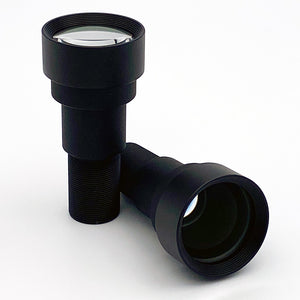
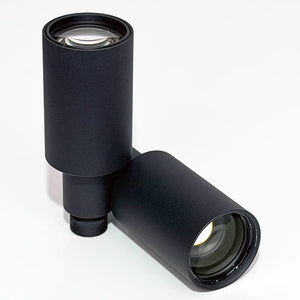
Choose a fixed focal length long enough to keep plate characters large on the sensor at the required working distance. For standoff distances of 20 to 50 meters, a 50mm telephoto M12 lens such as the CIL051 is a proven starting point; for longer distances or when iris control matters, a 75mm C-mount lens such as the CIL579 adds adjustable F/3-F/20 aperture for depth-of-field control.

ANPR and ALPR software reads plate characters from pixel data. It cannot infer characters that were never resolved on the sensor. The optical chain has to deliver four things before software can do anything useful: enough pixels on the plate (a widely used minimum is 20 to 30 pixels across a character height, below which ambiguous characters like B/8, O/0, and I/1 become unreliable), sharp focus across the full range of plate distances in the lane, motion blur held to a small fraction of a character's stroke width during the exposure, and adequate contrast, typically from matched NIR illumination and a bandpass filter.

Key principle

Telephoto helps with pixel density. Adjustable aperture helps with depth of field, within the limits diffraction sets on small-pixel sensors. A fast shutter, usually a strobed-NIR exposure of tens of microseconds, keeps motion blur to a small fraction of character stroke width. NIR illumination helps with contrast. No single lens choice guarantees all four. Each failure mode has to be checked separately.

Sizing focal length and pixels on target

The focal length formula is the same EFL relationship used throughout this article: f = WD × sensor_size / FOV_width. Once a focal length candidate is set, verify pixels per character height directly: pixels per character = sensor_pixels_V × character_height / FOV_height. Character height, not plate width, is what the OCR minimum is stated against. A horizontal pixel allotment across plate width is not comparable to a vertical per-character threshold. A standard North American plate is 300mm wide and roughly 70mm tall for the character zone; a European plate is 520mm wide.

パラメータValue
作動距離25,000mm (25m)
Sensor (1/2.3", 12MP)6.17mm H × 4.55mm V, 4000 × 3000px
Required FOV width3,600mm (fits a 3.6m lane)
Calculated focal length25,000 × 6.17 / 3,600 ≈ 43mm → use 50mm
Pixel scale at 50mm4000px / 3,080mm ≈ 1.30 px/mm
Pixels on 70mm character height70mm × 1.30 px/mm ≈ 91px per character, which passes the 20-30px minimum

Work through your own geometry with the Commonlands field-of-view calculator or the angle of view calculator.

Why telephoto alone can still fail

At 100 km/h a vehicle moves roughly 28mm per millisecond. On a 12MP sensor at 25m with a 50mm lens, the pixel scale is roughly 1.30 px/mm (4000px / 3,080mm FOV width), so 28mm of motion in 1ms represents on the order of 37 pixels of lateral blur, enough to make characters unreadable. Getting blur down to sub-pixel at this geometry takes an exposure of roughly 0.77mm / 27.8mm-per-ms ≈ 0.028ms (about 28 microseconds), which is impractical with a mechanical or electronic global shutter alone at useful illumination levels. In practice, ITS systems hit this target with a strobed NIR illuminator: the strobe pulse, not the camera's exposure window, defines the effective integration time, so tens of microseconds of light is achievable without starving the sensor. Where strobing isn't available, treat the target as a realistic blur budget (a small fraction of a character's stroke width, typically a few pixels) rather than a literal sub-pixel requirement. Telephoto magnifies the scene, so it magnifies motion blur proportionally rather than reducing it.

Longer focal lengths also produce shallower depth of field. If vehicles queue at varying distances, some plates may fall outside the depth of field and go soft. A C-mount lens with adjustable aperture can extend depth of field by stopping down, but only up to the point where diffraction takes over: on small-pixel sensors, the Airy disk grows with F-number and eventually spreads a point of light across multiple pixels, undoing the sharpness gain from stopping down. As a rule of thumb, the useful stop-down limit is roughly N <≈ pixel pitch / (1.22×λ), around F/2.3 for sub-2µm pixels at 550nm before the Airy radius exceeds one pixel. By that same one-pixel-radius criterion, F/8 stays diffraction-safe only on pixels of roughly 5µm or larger and F/16 only on pixels of roughly 11µm or larger; on a 1.5-2µm pixel sensor, stopping much past roughly F/3 can cost more sharpness to diffraction than it gains in depth of field. Confirm the diffraction limit against the sensor's pixel pitch before committing to a stop-down aperture, and recover the resulting exposure loss with illumination power or the strobe duration rather than a longer rolling exposure.

Telephoto does not add light either. Irradiance from a co-located NIR illuminator falls off with the inverse square of distance, so doubling working distance requires roughly four times the illumination power to hold the same exposure. Most production LPR installations use dedicated 850nm or 940nm NIR illuminators sized for the worst-case working distance, paired with an IR bandpass filter on the lens to suppress headlight glare and daylight variation. Camera angle matters too: a 30-degree oblique view compresses a 300mm plate to roughly 260mm apparent width, cutting pixels per character by about 13%, and no amount of focal length compensates for that.

M12 vs C-mount for plate-reading systems

M12 lenses fit directly onto embedded camera boards and cover most compact, controlled-illumination LPR deployments. Telephoto M12 options such as the CIL051 (50mm) and CIL350 (35mm) handle parking-lot and entry-lane reads well. C-mount is worth the added size and cost when depth of field is tight and working distance varies across the lane, when the sensor exceeds the M12 lens's rated image circle, or when the deployment needs the adjustable iris of the CIL579 (F/3-F/20) for depth-of-field control without changing the optics.

Low distortion helps preserve character geometry but is rarely the primary LPR failure mode. The CIL051 is rated at 0.1% TV distortion and the CIL350 at 0.4% TV distortion. Distortion figures are only comparable when they use the same metric, since TV distortion and optical (radial) distortion have non-comparable magnitudes. Pick the lens for focal length and aperture first, then confirm distortion is within budget against each lens's own datasheet.

How do glare, headlights, and low light affect ITS lens choice?

Outdoor ITS imaging is one of the more demanding environments in machine vision: uncontrolled ambient light, direct headlight exposure, retroreflective license plates, and temperature swings across day and night cycles create tradeoffs that controlled factory inspection never sees.

Fast aperture for low light

A fast lens (F/1.4 or F/2.8) collects more light per unit time and lowers the minimum illumination needed for a clean image. The CIL522 and CIL525, both F/1.4, are strong choices for low-light ITS work where ambient or strobe illumination is limited. At maximum aperture depth of field is shallow, and the lens operates at its widest point, where off-axis aberrations and vignetting are largest.

For NIR-illuminated systems, confirm the lens is IR-corrected to minimize focus shift between visible and near-infrared wavelengths.

Headlight glare

Headlights cause blooming and flare near wide-open aperture. Stopping down reduces peak sensor intensity and cleans up nighttime images where headlights dominate the frame. This is one reason the CIL579 (F/3 to F/20) is useful for longer-distance ITS work: the ability to stop down to F/8 or F/11 gives the system a path to controlling headlight contribution without changing camera gain. Lens coatings also affect flare performance; anti-reflective coatings reduce internal reflections that amplify glare in bright-on-dark scenes.

Watch for

A fixed-aperture M12 lens in a deployment with documented headlight glare leaves only camera exposure and gain control as mitigation, which has limits and can degrade image quality in mixed-illumination scenes.

Day/night filter switching and thermal drift

Many outdoor ITS cameras use an IR cut filter switcher that swings a filter in and out of the optical path with ambient light level. If the system uses this architecture, the lens must hold focus registration across the transition, or the system needs a motorized focus adjustment to compensate. Outdoor mounts also expand and contract with temperature: over a 30 to 40 degree Celsius day/night cycle, a lens that is not thermally compensated or mechanically locked can shift focus enough to soften the image. For fixed-mount systems running continuously without manual refocus, check the lens's thermal focus drift specification against the system's depth-of-focus budget.

Sensor and shutter type

Prefer a global shutter sensor for fast-moving vehicles imaged under ambient-light exposure, since rolling-shutter readout skews and smears vehicle profiles and plates as the frame is scanned. Rolling shutter is workable when a synchronized strobe defines the exposure window instead: the strobe pulse, not the sensor's rolling readout, sets the effective integration time, and production ANPR systems commonly pair rolling-shutter sensors with synchronized NIR strobes for exactly this reason. Whether rolling-shutter distortion is acceptable depends on sensor readout time relative to image-plane velocity, not on vehicle speed alone. See the global shutter vs rolling shutter section for the full selection guidance.

Lens selection must match the sensor format, which determines the required image circle and usable sensor diagonal; see image sensor selection for machine vision and sensor size and lens compatibility.

Top lenses for ITS and license plate recognition

For most intelligent transportation and license plate recognition cameras, a Commonlands C-mount prime in the 12mm to 75mm range covers the job: the 25mm CIL525 for general lane monitoring, the 50mm CIL536 for speed-enforcement plate reads, and the 75mm CIL579 (F/3 to F/20 adjustable iris) for long-standoff tolling. On embedded camera boards, the 50mm CIL051 telephoto M12 lens handles compact LPR at 20 to 50 meters. The table below maps each ITS task to a starting lens; size the focal length against your own mounting distance and sensor with the field-of-view calculator before ordering.

How we picked

Each lens is matched to the working distance and the pixel budget its task demands: pixels per character height for plate reading, per-vehicle pixel density for detection. We then checked aperture control against the outdoor dynamic range and confirmed the image circle covers the sensor. Every spec below comes from the linked product page, not an estimate.

ITS task Lens マウント イーエフエル Iris Why this pick
License plate recognition (embedded, 20-50m standoff) CIL051 M12 50mm Fixed 0.1% TV distortion keeps character geometry clean, and the board-mount M12 body fits directly on embedded LPR cameras. The 35mm CIL350 covers shorter parking and entry-lane reads.
Traffic monitoring and lane occupancy (10-20m) CIL525 Cマウント 25mm F/1.4 Balanced field of view and magnification for one or two lanes, with an F/1.4 floor for low ambient light. The 12mm CIL522 widens out to a full intersection overview.
Speed enforcement (plate read at trigger frame) CIL536 Cマウント 50mm F/2.8 12MP at 1.85µm pixel pitch puts enough pixels on the plate at 20 to 30 meters to survive a strobe-frozen citation frame.
Tolling gantry (long standoff, angled mount) CIL579 Cマウント 75mm F/3-F/20 adjustable Stopping down to F/8 or F/11 holds depth of field across varying vehicle height in the lane and tames headlight glare at long range.

When one camera has to cover several standoff distances or the mounting geometry is not fixed, a motorized varifocal CCTV lens from a vendor like Computar or Fujinon is the better answer than a fixed prime. A fixed focal length wins once the working distance and framing are locked, since it holds calibration and costs less. Browse the telephoto M12 lens collection for the longer-reach embedded options.

IR補正12mm M12レンズ

CIL122-F2.0-M12A650

IR補正12mm M12レンズ

$59.00

View details
16mm M12レンズ CIL160 グローバルシャッター

CIL160-F1.9-M12B650

望遠16mm M12レンズ

$39.00

View details
25mm M12 Sマウントレンズ

CIL250-F2.0-M12A650

IR補正25mm M12レンズ

$99.00

View details
35mm M12レンズ

CIL350-F2.4-M12A650

望遠35mm M12レンズ

$59.00

View details
望遠50mm M12レンズ

CIL051-F2.8-M12ANIR

望遠50mm M12レンズ

$79.00

View details
14mm M12レンズ CIL142

CIL142-F2.6-M12ANIR

望遠14.2mm M12レンズ

$59.00

View details
有限共役用20mm M12レンズ

CIL121-F2.8-M12A650

望遠21.8mm M12レンズ

$70.00

View details
75mm M12レンズ

CIL076-F3.4-M12A650

75mm M12レンズ(赤外線補正済み)

$129.00

View details
IR補正済み 16mm M12レンズ

CIL162-F2.0-M12A650

IR補正付き 16mm M12レンズ 800万画素

$70.00

View details
100mm M12 望遠レンズ

CIL100-F3.6-M12A650

100mm M12 望遠レンズ

$149.00

View details

ITS lens selection checklist

Use this checklist to validate a lens selection for a traffic monitoring, LPR, speed enforcement, intersection, or tolling camera before ordering. Each item is a parameter that, if wrong, degrades image quality or causes a field failure that focal length alone cannot fix. Run through the full list even when the initial focal-length calculation looks correct, because a lens that fails in the field often does so because of one of these secondary parameters rather than the focal length itself.

  1. Confirm focal length from geometry. Use the EFL formula from mounting distance, sensor format, and required scene width. Verify with the EFL calculator.
  2. Check image circle covers the sensor diagonal. For example, 2/3" diagonal is about 11mm; 1/1.8" diagonal is about 8.9mm.
  3. Verify resolving power against pixel pitch. The lens must meet or exceed the sensor's sampling limit at the working aperture, and on small-pixel sensors check the diffraction limit (roughly N <≈ pixel pitch / (1.22×λ)) before committing to a stop-down aperture for depth of field.
  4. For plate reading, verify pixels per character. Compute pixels on plate at the chosen focal length and working distance, divide by character count, and compare against the OCR library's stated minimum, typically 20 to 30 pixels per character height.
  5. Check depth of field against the lane distance range. If vehicles queue or approach at varying distances, a C-mount lens with adjustable aperture gives room to stop down and extend depth of field.
  6. Specify shutter speed to freeze motion. Confirm exposure time keeps lateral motion to a small fraction of a character's stroke width (typically a few pixels) at the expected vehicle speed, using a strobed illuminator if the geometry demands sub-pixel-scale exposure, and that illumination supports that shutter speed.
  7. Confirm aperture range spans low light to bright sun. Look for F/1.4 or F/2.8 floor and F/8 to F/16 daytime stop-down.
  8. Confirm C-mount thread and flange distance (17.526mm) against the camera body; CS-mount bodies need a 5mm adapter.
  9. Check thermal focus drift against the system's depth-of-focus budget for the expected outdoor temperature range.
  10. Prefer global shutter for fast-moving vehicle imaging under ambient light (rolling shutter is workable with a synchronized strobe defining the exposure), and confirm IR correction plus bandpass filtering if NIR illumination is in use.
  11. Validate environmental sealing of lens and enclosure for the deployment's dust, rain, and humidity rating.
A pole-mounted ITS camera in a sealed enclosure aimed down a roadway capture zone
The lens frames a fixed capture zone at a known distance.

よくある質問

What lens is best for ITS traffic monitoring cameras?

A C-mount lens in the 25mm to 75mm range is the practical starting point for most ITS deployments. The right focal length depends on mounting distance and required lane coverage: 25mm suits 10-20m pole mounts, 50-75mm suits longer standoff or ANPR work. C-mount is preferred over M12 for outdoor ITS because it offers adjustable iris control and longer focal-length reach.

What lens should I use for license plate recognition?

Choose a fixed focal length long enough to keep plate characters large on the sensor at the required working distance. For standoff distances of 20 to 50 meters, a 50mm telephoto M12 lens such as the CIL051 is a proven starting point. For longer distances or when iris control matters, a 75mm C-mount lens such as the CIL579 gives adjustable F/3-F/20 aperture for depth-of-field control. Calculate the required focal length from plate size, sensor size, working distance, and minimum pixels per character before selecting.

Why are C-mount lenses common in ITS traffic monitoring?

Traffic cameras operate outdoors over working distances of roughly 10 to 20 meters and must handle bright midday sun, direct headlights at night, and low ambient light in the same deployment. An adjustable iris ring lets engineers stop down to control depth of field and reduce headlight glare without changing the camera body. C-mount also supports focal lengths from 4mm up to 75mm or longer, which M12 typically does not reach.

How do engineers choose focal length for traffic monitoring?

Focal length is derived from the required field of view given the mounting distance and sensor format: EFL = (sensor dimension × working distance) / field dimension. For example, a 2/3" sensor (horizontal about 8.8mm) mounted 15 meters from a lane, covering a 5-meter scene, requires approximately EFL = (8.8 × 15000) / 5000 = 26.4mm, so a 25mm lens is the practical match. Verify the geometry with the Commonlands EFL calculator before ordering.

How many pixels should be on a license plate for reliable OCR?

A widely used minimum is 20 to 30 pixels across the height of a plate character. Below that, ambiguous characters such as B/8, O/0, and I/1 become unreliable regardless of the OCR algorithm. Compute pixels per character directly from the vertical axis: sensor_pixels_V × character_height / FOV_height. A horizontal pixel allotment across plate width divided by character count is not the same measurement and should not be compared against a height-based OCR minimum.

Why can a telephoto lens still fail for plate recognition?

Telephoto narrows field of view and magnifies the plate, but it does not freeze motion blur, extend depth of field, or add illumination. At highway speed, a vehicle can smear tens of pixels during a 1ms exposure at typical ITS lens geometries, smearing characters even with the correct focal length. Motion, focus, and contrast have to be solved separately with shutter speed, aperture, and NIR illumination.

When should engineers use 25mm, 50mm, or 75mm ITS lenses?

25mm suits mid-range monitoring at roughly 10 to 20 meters where one or two lane widths need coverage with moderate target magnification. 50mm suits working distances of 20 to 30 meters or narrower scene widths that need more detail per pixel. 75mm suits long-range or bridge-mounted work at 30 meters or more, where aiming tolerance and mount stability become critical because small vibrations shift the frame significantly.

How do glare, headlights, and low light affect ITS lens choice?

A faster lens (lower F-number, such as F/1.4) collects more light at night but is more susceptible to headlight overexposure at maximum aperture. Stopping down to F/5.6 or F/8 reduces glare and can improve sharpness by reducing aberration blur, but diffraction blur grows as the aperture shrinks, so check the diffraction limit against pixel pitch and expect to need more illumination or a longer exposure. For NIR-illuminated systems, an IR-corrected lens is required to minimize focus shift between visible and near-infrared wavelengths.

What should engineers validate besides focal length in an ITS lens?

Sensor format coverage (image circle must cover the sensor diagonal), pixel-pitch compatibility, aperture range spanning low light to bright sun, thermal focus drift across the outdoor temperature range, mechanical aiming stability at the chosen focal length, global shutter for fast-moving vehicles, IR correction for NIR illumination, and environmental sealing for the enclosure rating required.

Do smart-city intersection cameras need a different lens than tolling gantries?

Yes. Intersection cameras for signal control and pedestrian detection typically prioritize wide field of view, often 4mm to 12mm C-mount, to see a full approach rather than isolate one distant target. Tolling gantries need OCR-grade plate reads at longer standoff and angled mounting, which pushes focal length toward 50mm to 75mm and makes adjustable iris more important for depth-of-field control across varying vehicle heights.

Related resources

Need help sizing an ITS lens?

Sensor format, aperture range, thermal stability, and shutter compatibility all affect whether an ITS camera performs reliably across a full deployment cycle. Commonlands engineers can review your working distance, sensor, and plate-pixel requirements and recommend the right focal length and mount type.