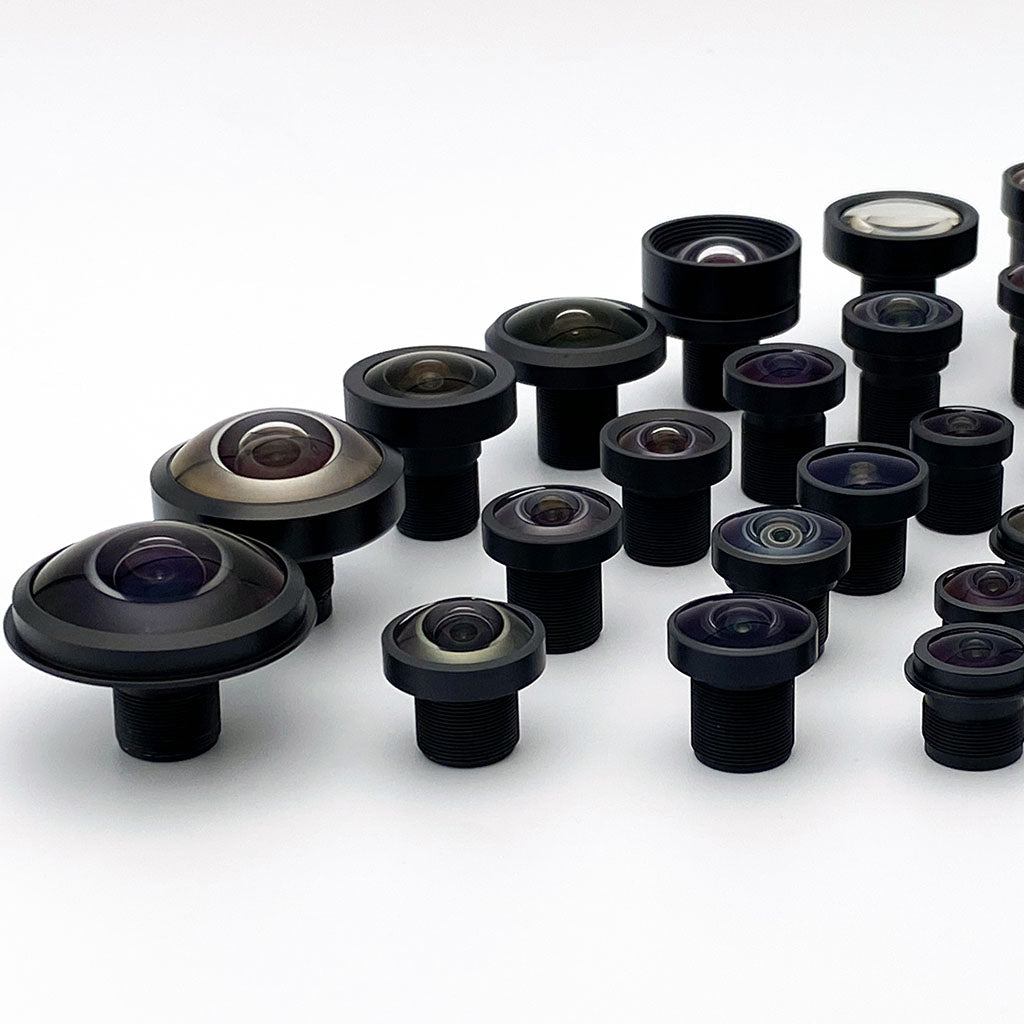

Cマウントレンズとは? フランジ焦点距離、手動絞り制御、およびCSマウントとの互換性
This guide covers the 1"-32 UN thread and 17.526mm flange focal distance, plus focus mechanisms and the adjustable iris. It also covers CS-mount compatibility and when C-mount beats M12.

A C-mount lens is a screw-thread lens standard using a 1"-32 UN thread and a fixed 17.526mm flange focal distance (FFD), the distance from the mount flange to the sensor plane. Adjustable C-mount lenses focus by rotating a ring, with the moving elements varying by design, and many include a manual iris ring for aperture control.
C-mount is the default industrial lens mount for machine vision: broad focal length selection, sensor coverage up to 1.2" and beyond on select lenses, and an adjustable iris that most M12 lenses do not have. CS-mount shares the thread with a shorter 12.526mm flange, and M12 is a different, smaller system entirely.
Cマウントレンズとは?
A C-mount lens uses a 1"-32 UN thread (one inch outer diameter, 32 threads per inch) and a specified 17.526mm flange focal distance. The thread and flange are the entire mechanical specification. C-mount bodies are machined to that FFD and C-mount lenses are designed against it, which is what makes cross-manufacturer pairing routine. That is nominal geometry, not a guarantee: real parts carry tolerance, and rear-element clearance, focus travel, image circle, and cover-glass thickness stay lens and camera specific.
Focus mechanism belongs to the design, not the mount. Rotating the focus ring on an adjustable C-mount lens may translate the whole optical cell in a helicoid, shift only the front group, or drive internal groups along a cam track. The datasheet for the lens you are evaluating, or a question to Commonlands engineering, settles which, along with how the image behaves at the near limit.
Fixed-focus C-mount products exist too, and all are equally C-mount. That is also different from M12 lenses, which are rigid assemblies focused by threading the whole body in or out.
A lens's specified minimum object distance may reflect available focus travel, image-quality requirements, or both. The measurement reference can vary by manufacturer, so use the drawing or datasheet definition. An extension tube can allow closer focus but changes the operating conditions and may reduce usable image quality. Working distance runs from around 100mm to infinity depending on the product. It is not a single fixed range across the catalog.
Beyond thread and flange, the standard says nothing about optical performance or sensor coverage. A 2.8mm wide lens and a 75mm telephoto are both C-mount. The mount is a mechanical interface, not a performance tier.
The nominal C-mount flange focal distance is 17.526mm. Use the camera and lens mechanical drawings to establish the allowed axial and angular variation from the mounting datum. The nominal dimension alone is not a tolerance specification. Where a camera's registration or cover glass sits off nominal, expect to refocus or shim.

What Is a CS-Mount Lens?
A CS-mount lens shares the same 1"-32 UN thread as a C-mount lens but uses a shorter 12.526mm flange focal distance instead of 17.526mm. The 5mm shorter optical path lets designers work with shorter back focal lengths, which is design freedom rather than a guaranteed simplification: element count and spectral correction follow from the prescription, field, aperture, and conjugates, not from the flange.
It is not a smaller version of C-mount optically. The flange geometry drives the whole lens design. Because the thread is identical, either lens screws into either body wherever the rear group clears the throat. Whether it focuses is a separate question.
| パラメータ | CSマウント | Cマウント |
|---|---|---|
| スレッド | 1"-32 UN | 1"-32 UN |
| フランジ焦点距離 | 12.526mm | 17.526mm |
| 一般的なセンサーの最大検知範囲 | 約2/3インチ | 一部のレンズでは1.2インチ以上 |
| 代表的な焦点距離の範囲 | 約2.5mm~16mm | 2.8mm~100mm+ |
| 一般的な用途 | CCTV、ITS、セキュリティ、Raspberry Pi HQのプロトタイピング | 産業用マシンビジョン、科学用イメージング |
A C-mount lens on a CS-mount camera works with a 5mm C-to-CS spacer adapter that restores the 17.526mm distance. Without it, the flange sits 5mm closer to the sensor than the lens expects: at infinity the image forms behind the sensor plane, and focusing closer moves it further back. No normal focus travel covers a 5mm deficit. Many CS-mount cameras ship with the spacer, and the CLA217-CCS adapter ($6.00) provides the correction.
A CS-mount lens on a C-mount camera loses infinity focus, and no passive spacer brings it back. The sensor sits 17.526mm back, 5mm farther than the lens is designed for, and spacers only add path length, never remove it.
What that extra 5mm does is act as an extension tube, so the pairing still focuses at close range, at working distances far shorter than the lens markings suggest. How close it lands is lens-specific, so measure the pairing rather than assume it. For infinity or normal standoff, use C-mount lenses.
CS-mount is common in ITS (intelligent transportation systems) and security cameras, where the shorter flange suits the wide, fast designs those cameras use. Correction at 850nm or 940nm for license-plate and night work is a property of the design, not the mount.
CS is also the native mount on the C/CS version of the Raspberry Pi High Quality Camera, which takes CS-mount lenses directly and C-mount lenses with the 5mm spacer. For most machine vision, particularly sensors above 2/3" or focal lengths above 16mm, C-mount stays the default. Browse the Commonlands CS-mount collection.
What Is a Manual Iris Lens?
A manual iris lens has a physical iris ring the user rotates to set the aperture (F#), then locks. There is no motor and no feedback circuit. That differs from a fixed-iris lens, common on M12, where aperture is set at the factory. It also differs from an auto-iris lens, which uses an electronic actuator to track scene brightness.
Manual iris is common on C-mount machine vision lenses, but iris type is a lens feature, not part of the mount: fixed, manual, DC auto-iris, P-iris, and motorized C-mount lenses all exist.
Adjustable iris control is the single biggest practical advantage of C-mount over M12 for machine vision. Stopping down raises depth of field. Opening the iris lowers it. Because machine vision illumination is usually LED-based and programmable, engineers can stop down to gain depth of field and then drive the lighting harder to recover the lost throughput. That tradeoff is impractical in ambient-light photography but routine on a production line. Commonlands C-mount lenses carry a manual iris for exactly this control.
| アイリス型 | 絞り値は誰が設定するのですか | 代表的な用途 |
|---|---|---|
| 手動絞り | リング付きのユーザーは、展開前にロックされました | プログラム可能な照明機能を備えたCマウント式マシンビジョン |
| 固定式アイリス | 工場出荷時の設定であり、調整はできません | M12対応の組み込みおよび低コスト用途 |
| オートアイリス | 現場の明るさに応答する電子アクチュエータ | 屋外用防犯カメラ、可変照明監視 |
What Is an Industrial Lens?
An industrial lens is a lens selected for machine vision, robotics, automation, inspection, or scientific imaging, where image geometry and repeatability matter more than photographic look. The term is not tied to one mount or price point. It names a set of engineering priorities. Repeatable geometry comes first: once focused and locked, field of view and distortion should stay constant across units and production runs, because a calibrated algorithm cannot tolerate geometry that shifts by serial number.
The table describes what is typical of each category, not what any mount or standard requires. Individual products cross the lines.
| プロパティ | 産業用レンズ | 民生用レンズ | 防犯カメラのレンズ |
|---|---|---|---|
| 歪み特性 | 発表および特性評価 | マシンビジョンでは、多くの場合、指定されない | 明記されることはめったにないが、通常はより高い |
| 絞り制御 | 手動アイリス(Cマウント)または固定式(M12) | Usually electronic, via the camera body | Manual iris, DC auto-iris, or fixed |
| フォーカスロック | 止めネジまたはロックリング | Usually none. Most are autofocus | 時には、しばしば摩擦のみ |
| マウント規格 | Cマウント、CSマウント、M12 | Camera-brand mounts (E, F, RF, L) | Cマウント、CSマウント |
C-mount and M12 are the two dominant industrial mounts, with CS-mount a close variant of C-mount on a 5mm shorter flange. Neither C-mount nor M12 is universally better. Choose on sensor size, aperture control, and packaging. Commonlands makes lenses in all three mounts, and the C-mount vs M12 comparison below covers the decision.
Sensor Size and Image Circle Coverage
C-mount specifies the mechanical interface, not sensor coverage. Coverage is set by the lens image circle, the diameter of the usable projected image at the focal plane. If the image circle is smaller than the sensor diagonal, the corners go dark, a defect called vignetting. Corners can also go soft where the field exceeds the lens's corrected image circle, a separate resolution effect. Always check image circle against sensor diagonal, or pick a lens rated for a larger format than you need.
| センサーフォーマット | 対角線の長さ(約) | 代表的なレンズのランク分け |
|---|---|---|
| 1/3インチ | 6.0mm | エントリー Cマウント、CSマウント、CCTV |
| 1/2インチ | 8.0mm | ミッドレンジのM12およびCマウント |
| 2/3インチ | 約11.0mm | 標準的な産業用Cマウント |
| 1" | 約16.0mm | 高解像度のCマウント |
| 1.1" | 約17.6mm | 高解像度 12~25MP 産業用 |
Corner performance is not uniform even within a rating. Commonlands publishes an image circle for every C-mount and CS-mount lens, so the check against your sensor diagonal is direct. See the sensor size and lens compatibility guide for format matching.
C-Mount vs M12: Which Should You Choose?
Choose C-mount when you need an adjustable iris for depth-of-field control, sensor coverage above roughly 1/1.8", or focal lengths past 50mm. Choose M12 when size, weight, and cost dominate: embedded cameras, drones, and small robotics platforms are its natural home. C-mount and M12 are different focus systems, not scaled versions of each other.
Mount type does not establish element count, mechanical tolerance, or price. Compare the actual lenses and their focus, iris, image-circle, and image-quality specifications. The bigger factor is integration: C-mount's standardized flange gives a lens and camera from separate vendors the same nominal registration, while M12 back focal length varies enough that every pairing must be checked against the holder height in the datasheet.
For the full mount comparison including M8, see the lens mount guide, and browse the Commonlands M12 lens collection for compact options.
Top 5 C-Mount and CS-Mount Lenses for Machine Vision
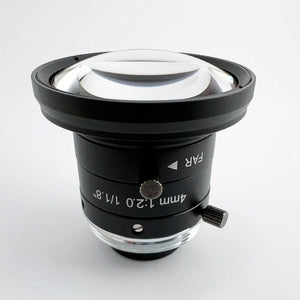
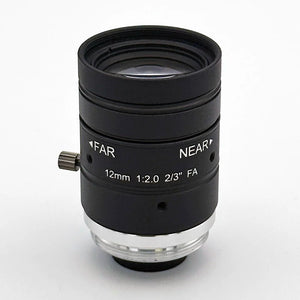
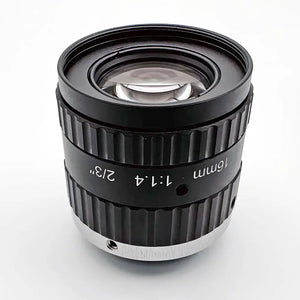
The five Commonlands lenses below cover common C-mount machine vision roles, from an 8mm wide-area lens (CIL531, 2/3", F/2.8) to a 25mm high-resolution option for 1.1" 20MP sensors (CIL544, F/1.8). The CIL725 2.5mm fisheye is CS-mount, included for Raspberry Pi HQ and panoramic builds. Every lens carries an adjustable iris, the control that separates C-mount from most M12 optics.
| ランク | レンズ | マウント | EFL | F# / アイリス | フォーマットの対応範囲 | こんな方に最適 |
|---|---|---|---|---|---|---|
| 1 | CIL531 8mm | Cマウント | 8mm | F/2.8, adjustable | 最大2/3インチ、1200万画素 | 広範囲にわたる空中ロボット技術と大面積検査 |
| 2 | CIL522 12mm | Cマウント | 12mm | F/1.4, adjustable | 最大2/3インチ、4.2ミクロンで300万画素 | 明るい汎用検査用基準線 |
| 3 | CIL535 35mm | Cマウント | 35mm | F/2.0~F/16、調整可能 | 最大2/3インチ、2.2ミクロンで1200万画素 | より長いスタンドオフ式コンベアおよびガントリー検査 |
| 4 | CIL544 25mm | Cマウント | 25mm | F/1.8、調整可能 | 1.1インチ、20MP以上(2.74ミクロン) | 大型センサーにおける高解像度測定 |
| 5 | CIL725 2.5mm | CSマウント | 2.5mm | F/1.8-F/14, adjustable | 6.4mm image circle. A complete circular image requires a sensor short side of at least 6.4mm. A smaller short side crops the circle | パノラマおよびRaspberry Pi HQの構築 |
How we picked: every lens is stocked at Commonlands with a published image circle and an adjustable iris, and each fills a distinct role so the five span wide-area through high-resolution work. Size focal length from your working distance and sensor width in the EFL calculator, and confirm image circle against your sensor diagonal before ordering.
フジノン、コーワ、コンピュターは、CマウントFAレンズの老舗メーカーであり、エドマンド・オプティクスもTECHSPECシリーズとして幅広いCマウント製品を取り揃えています。これらのメーカーは、長焦点距離や1.1インチを超えるフォーマットにおいて製品ラインナップが充実しているため、そうした用途においては依然として基準となる存在です。コモンランズは、直接販売価格、サンディエゴの在庫による即日出荷、そして光学系を仕様決定するエンジニアへの直接アクセスといった点で競争力を発揮しています。


よくある質問
Commonlands C-mount lenses pair a manual iris with working distances from typically 100mm to infinity. These answers cover the standard behind them.
Cマウントレンズとは何ですか?
A C-mount lens is a screw-thread lens using 1"-32 UN thread and a 17.526mm flange focal distance. The standard defines the mechanical interface between lens and camera body, so lenses and cameras from different manufacturers start at the same nominal registration. Focus tolerance, rear-element clearance, image circle, and the camera's sensor stack still have to be checked per pairing. Many include an adjustable iris ring, and adjustable models focus by ring rotation. Which elements move and how focus behaves at the near limit differ from design to design.
Cマウントレンズのフランジ焦点距離はどれくらいですか?
17.526mm, measured from the lens mount flange to the sensor plane. C-mount camera bodies are machined to this distance, and C-mount lenses are designed with a matching flange focal distance. CS-mount uses the same thread with a 12.526mm flange instead, a 5mm difference that governs adapter use.
Cマウントのレンズは、CSマウントのカメラで使用できますか?
Yes, with a 5mm C-to-CS spacer adapter that restores the 17.526mm flange distance. Without it, the flange sits 5mm closer to the sensor than the lens expects, the image forms behind the sensor plane, and no normal focus travel covers a 5mm deficit. Many CS-mount industrial cameras ship with this spacer included. The CLA217-CCS adapter provides the correction for $6.00.
CSマウントのレンズは、Cマウントのカメラで使用できますか?
Not for normal use. A CS-mount lens is designed for a 12.526mm flange distance, and a C-mount camera places the sensor 17.526mm back. Spacers only add optical path length, and none can shorten it, so infinity focus is gone and no passive spacer restores it. The extra 5mm behaves like an extension tube, so the pairing still focuses at close range, well inside the lens's marked distances, though how close depends on the lens. Treat it as a macro workaround rather than a compatible combination.
どのような場合に、M12ではなくCマウントを選ぶべきでしょうか?
被写界深度の制御のために絞り調整機能が必要な場合、センサーサイズがおよそ1/1.8"を超える場合、または50mmを超える焦点距離を含む幅広い焦点距離が必要な場合は、Cマウントを選択してください。組み込みカメラ、ドローン、小型ロボットプラットフォームなど、サイズ、重量、コストが主な制約となる場合は、M12を選択してください。詳細な比較については、レンズマウントガイドをご覧ください。
Need Help Choosing a C-Mount Lens?
Commonlands manufactures C-mount, CS-mount, and M12 lenses for machine vision and embedded vision. Lens designs are MTF characterized against design specifications. Send our San Diego engineering team your sensor model and application at engineering@commonlands.com or call +1 (858) 333-7325. Orders placed before 12 PM PT ship same day.