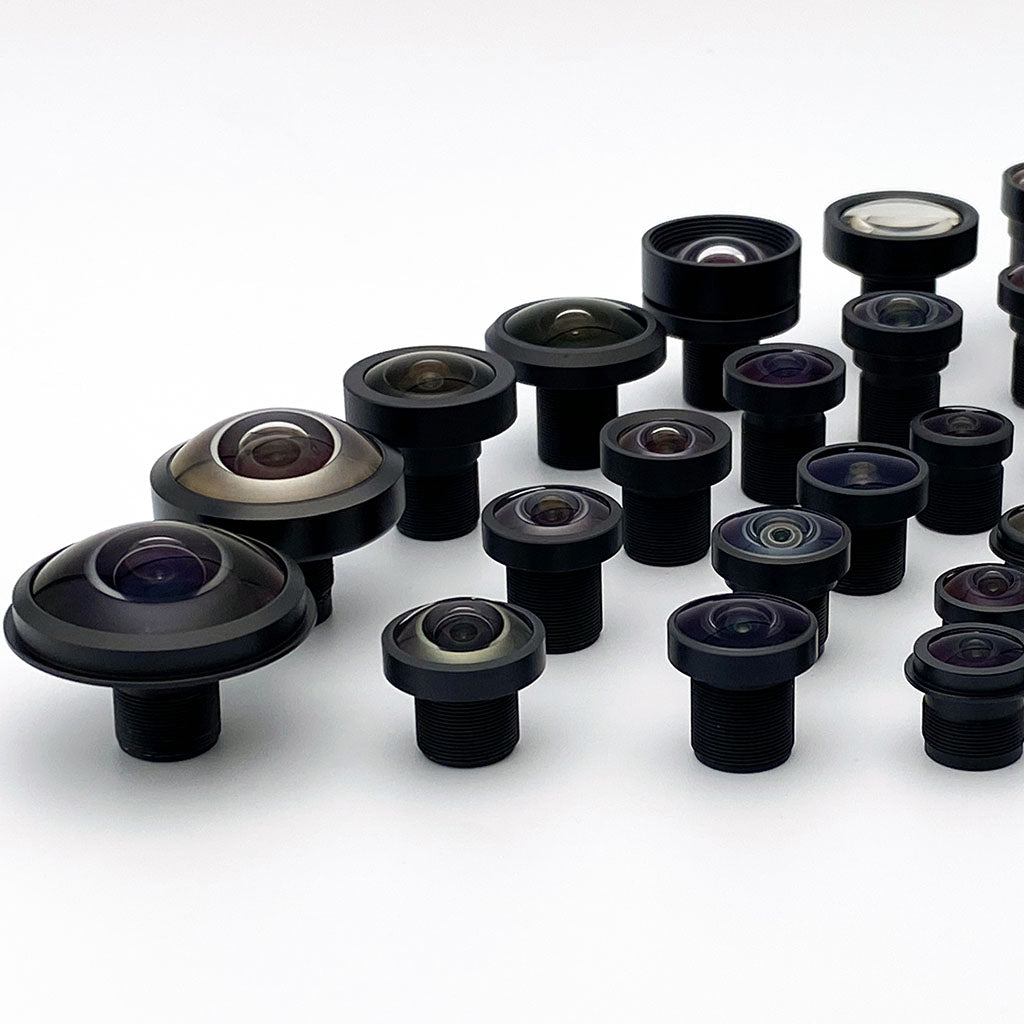

マシンビジョンにおけるセンサーサイズとレンズの互換性:イメージサークル、ヴィネット現象、および相対照度
This guide shows how to match a lens to a sensor: coverage math, vignetting mechanisms, and the relative illumination curve that combines them.

A lens matches a sensor when its image circle diameter equals or exceeds the sensor diagonal, with margin left for corner sharpness. That comparison is necessary but not sufficient, and the image circle figure means little without its criterion. After coverage you still check mechanical vignetting, aperture-dependent optical vignetting, the natural falloff of the projection that cos4 models to first order, and chief ray angle (CRA) match to the sensor's microlens array. For sensor format dimensions, naming conventions, and diagonal charts, see the CMOS sensor size guide.
レンズが自分のセンサーをカバーしているかどうかは、どうすればわかりますか?
Compare the lens image circle diameter to the sensor diagonal. Clearing the diagonal is necessary, not sufficient: an image circle figure means little until you know the criterion behind it, which is the relative illumination or MTF the vendor still holds at that radius, and at which aperture, wavelength, and conjugate. Ask for that criterion. Below the diagonal the corners darken, from shading to black depending on the lens. Calculate the diagonal from the active area, not from the format name.
Coverage on its own says nothing about chief ray angle or mechanics. A mechanical fit (mount, flange distance, rear clearance) and an optical fit (image circle criterion, CRA, relative illumination) both have to hold, and a correct mount does not rule out vignetting.
For a 1/2-inch sensor with a 6.4 × 4.8mm active area: diagonal = √(40.96 + 23.04) = √64 = 8.0mm. That sensor needs an image circle of at least 8.0mm plus margin. Round the diagonal up and the lens's rated image circle down before comparing, so a borderline pairing is judged conservatively.
センサーフォーマットの参考値と最小像円
Sensor formats Commonlands lenses cover, with the minimum image circle each needs to reach the diagonal.
| センサーフォーマット | 代表的な有効面積(mm) | 対角線(mm) | 最小像円 | 代表的なレンズの分類 |
|---|---|---|---|---|
| 1/4インチ | 3.6 × 2.7 | 4.5 | 4.5mm+ | M12 |
| 1/3インチ | 4.8 × 3.6 | 6.0 | 6.0mm以上 | M12 |
| 1/2.9インチ | 5.6 × 3.2 | 6.4 | 6.4mm以上 | M12 |
| 1/2.7インチ | 5.3 × 4.0 | 6.6 | 6.6mm以上 | M12 |
| 1/2.5インチ | 5.8 × 4.3 | 7.2 | 7.2mm以上 | M12 |
| 1/2インチ | 6.4 × 4.8 | 8.0 | 8.0mm以上 | M12 または Cマウント |
| 1/1.8インチ | 7.2 × 5.4 | 9.0 | 9.0mm以上 | M12 または Cマウント |
| 1/1.7インチ | 7.6 × 5.7 | 9.5 | 9.5mm以上 | M12 または Cマウント |
| 2/3インチ | 8.8 × 6.6 | 11.0 | 11.0mm以上 | Cマウント |
| 1" | 12.8 × 9.6 | 16.0 | 16.0mm以上 | Cマウント |
| 1.1" | 14.1 × 10.35 | 17.5 | 17.5mm以上 | Cマウント |
Active area varies by manufacturer and model within one format label, so use the exact width and height from the sensor datasheet, or the image sensors database.

マシンビジョンにおいて、ヴィネット現象はどのような原因で発生するのでしょうか?
Vignetting has three mechanisms, each with a different fix. Mechanical vignetting is ray clipping by physical apertures: barrel bores, retainers, filter threads, and the mount cut into off-axis bundles whatever the iris is set to. A published image circle is the usable field that clipping leaves under the vendor's criterion, and illumination or aberration can set that limit first. Beyond the published circle, performance is unspecified: expect gradual shading and aberration growth, with hard clipping only at the mechanical cutoff.
Optical vignetting is aperture-dependent roll-off, from off-axis bundles seeing a smaller effective aperture. It is worst wide open and improves as you stop down, which a C-mount iris ring lets you do. Most M12 lenses have no iris and are fixed at manufacture. Natural falloff is what remains when nothing is clipped, and cos4 models it to first order for a rectilinear lens whose pupil magnification is near one.
At a 20° half-angle, cos4 gives about a 22% drop. At 30°, the drop is about 44%. At 45°, it reaches about 75%. The half-angle that matters for corners is the diagonal one set by the sensor, not the horizontal field, so a lens with a 30° horizontal half-angle has a larger corner angle and a larger loss.
Those figures are a first-order reference, not a floor and not a ceiling. Measured relative illumination sits above or below cos4 depending on projection, pupil aberration, and pupil magnification, and it moves with aperture wherever optical vignetting is also present. Wide-angle and fisheye designs routinely beat the model. A lens with heavy mechanical vignetting falls under it. Read the measured curve.
How to tell the three vignetting mechanisms apart when choosing a Commonlands lens: match the symptom to its mechanism and fix.
| 症状 | 考えられるメカニズム | まず確認 | 絞れば解決できる? |
|---|---|---|---|
| 硬く黒い角、鋭い境界線 | 機械的なヴィネット効果 | イメージサークルとセンサーの対角線を比較する | Correct the obstructing aperture. A different holder, filter mount, accessory, or lens may be needed |
| 滑らかな放射状の減光特性で、絞り込んだ際の画質が向上する | 光学的なヴィネット現象 | Measure relative illumination at multiple F# settings | はい、Cマウントで、絞りリング付きです |
| 滑らかな放射状の減光、絞り込んでも変化なし | Natural falloff, modeled to first order by cos4 | Compare the calculated corner (diagonal) half-angle falloff with the measured curve | No. Projection geometry sets it. Stopping down moves the measured curve only where optical vignetting is also present, and magnitude depends on the design |
| 色調の変化を伴う隅の黒ずみ | CRAの不一致(下記参照) | レンズのCRA曲線とセンサーのマイクロレンズの仕様を比較する | Per-channel calibration can reduce repeatable color shading, but cannot recover lost SNR or arbitrary angular crosstalk |
Flat-field correction rescales what the sensor actually recorded. It cannot recover a corner that read zero or clipped at saturation, it cannot rebuild SNR or MTF that were never captured, and it fails on color-dependent angular crosstalk and on shading that drifts with illuminant, temperature, or focus. Where corner quality drives the pass/fail decision, fix the optics first and treat correction as cleanup, not the primary fix.
レンズにおける相対照度とは何ですか?
Relative illumination is the normalized brightness at a field position, expressed as a ratio to the on-axis illuminance. A lens at 70% relative illumination in the corner delivers 30% less light there than at center under the same exposure. It is the lens-side curve that combines mechanical vignetting, optical vignetting, and cos4 falloff. Sensor microlens CRA mismatch adds corner falloff at the camera-system level, not within the lens curve itself unless it is measured through the sensor.
A low distortion spec does not buy corner brightness: a lens under 0.2% distortion can still sit at 50% relative illumination at the corner, so check both specs separately for dimensional work.
What feeds the relative illumination curve on a Commonlands M12 or C-mount lens, and what changes each contributor.
| 寄与メカニズム | 変更点 | 解決策は? |
|---|---|---|
| Natural roll-off (cos4 model) | To first order, illuminance falls as the fourth power of the cosine of the field half-angle under rectilinear projection. Measured curves land above or below the model depending on projection, pupil aberration, and pupil magnification | Largely fixed by projection geometry for rectilinear designs. Accept it or choose a longer focal length, or a lens whose projection is intentionally engineered to reduce it |
| 光学(開口)ヴィネット | 斜め光線束は、有効開口が縮小して見える | Stop down the iris on C-mount. Most M12 lenses are fixed at design |
| 機械的なヴィネット効果 | Barrels, retainers, and mount bores clip off-axis bundles. The rated image circle marks where usable field ends under the vendor's criterion | Use a lens with a larger rated image circle, and confirm the criterion behind that rating |
| CRAの不一致 | コーナーにおける主光線角が、センサーのマイクロレンズ設計と一致しない | センサーの仕様に合ったCRAプロファイルを持つレンズを選択してください |
| フィルター/ウィンドウスタック | An interference coating's passband shifts and broadens with incidence angle, and every ray in the f-number cone at a field point arrives at a different angle, so the full cone sets the shift while the chief ray only marks its center. Fresnel loss also rises at those angles, and a plane plate in converging light adds aberration | Specify filters against the corner cone angles and the band actually in use, not the chief ray alone. A slower cone or an angle-tolerant coating narrows the spread |
イメージサークルが十分に大きくなれば、CRAは重要ではなくなるのでしょうか?
Yes. Chief ray angle (CRA) is the angle at which the principal ray reaches the sensor at a given field position: near zero at center, oblique at the corners. CMOS sensors have microlens arrays shaped for a CRA profile that varies with field height, so a corner mismatch steers light away from the photodiode and corner sensitivity drops.
Request the lens CRA profile at 0°, half-field, and full-field, and compare it against the sensor's microlens CRA at the same heights. A full-field mismatch beyond the sensor's rated CRA acceptance tolerance produces measurable corner shading. That tolerance is sensor-specific, so read it from the sensor datasheet rather than assuming a threshold. Ask the manufacturer if it is not published. Commonlands supplies CRA data where available for its M12 and C-mount lenses.
フィッシュアイのフィルファクター:画角のルールにおける意図的な例外
Standard lenses are specified so the image circle covers the sensor diagonal. Fisheye systems deliberately vary that ratio, because a fisheye still has a defined image circle. A complete circular image needs the circle to fit inside the sensor's short dimension, not just the diagonal, so a circle can clear the diagonal and still be clipped top and bottom.
How a Commonlands fisheye lens fills different sensors, set by the image-circle-to-sensor ratio.
| 塗りつぶしモード | イメージサークルとセンサー | センサーが捉えるもの | 代表的な用途 |
|---|---|---|---|
| 円形フィッシュアイ | イメージサークルがセンサーの短辺よりも小さい | Complete circular image with black corners. Maximum fisheye FOV visible | 360度撮影、パノラマ撮影 |
| フルフレーム・フィッシュアイ | イメージサークルがセンサーの対角線上、またはそのすぐ上にある | フィッシュアイの映像が画面の端から端まで埋め尽くす | SLAM、ロボティクス、サラウンドビューシステム |
| トリミングしたフィッシュアイ | イメージサークルがセンサーの対角線より大きい | Sensor captures only the central region. Narrower effective FOV, with the high-distortion outer field cropped out rather than corrected | 適度な画角の広角フィッシュアイレンズを使用したコンパクトな組み込みシステム |
各種フォーマットにおけるコモンランズの製品事例
These Commonlands lenses show how image circle, sensor format, and mount scale together.
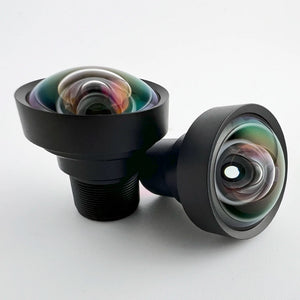
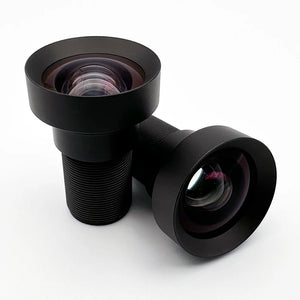
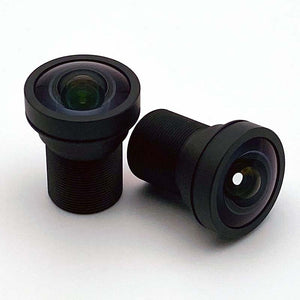
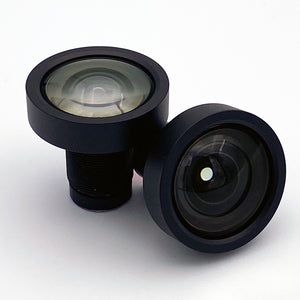
センサー形式別のおすすめレンズ
This table maps common formats to a Commonlands lens whose published image circle clears the sensor diagonal, reusing the diagonals from the reference table above.
| センサーフォーマット | 対角線(mm) | センサーの例/用途 | コモンランズレンズのおすすめ | レンズの像円 |
|---|---|---|---|---|
| 1/4インチ | 4.5 | 低コストの監視、ウェブカメラ | CIL343 4.4mm M12 | 8.8mm-9.7mm. Oversized for 1/4" |
| 1/3インチ | 6.0 | 防犯カメラ、ドローン | CIL062 6mm M12 | 9.0mm |
| 1/2インチ | 8.0 | コンパクトカメラ、ドローン | CIL085 8mm M12 | 8.9mm |
| 2/3インチ | 11.0 | グローバルシャッター式マシンビジョン | CIL522 12mm Cマウント | 11.4mm |
| 1" | 16.0 | グローバルシャッター式マシンビジョン | CIL544 25mm Cマウント | 17.6mm |
The CIL544 covers 1.1-inch sensors, the top of the Commonlands C-mount range. Large-format C-mount lenses from Fujinon, Kowa, or Edmund Optics reach 4/3-inch. Larger formats such as APS-C require a lens image circle and ray clearance suitable for the active area. The sensor diagonal does not need to fit through the mount bore. Check off-axis ray clearance through the mount and filters, along with image quality across the field. Larger mounts are common for these formats.

よくある質問
These answers apply to any lens and sensor pair. Commonlands lists image circle in millimeters for its M12 and C-mount lenses.
イメージサークルが十分に大きくなれば、CRAは重要ではなくなるのでしょうか?
はい。主光線角とは、センサーの隅で光がレンズから出る角度を指します。これがセンサーのマイクロレンズアレイの設計角度と一致しない場合、マイクロレンズはその光をフォトダイオードに効率的に導くことができません。その結果、イメージサークルがセンサーを完全に覆っている場合でも、隅の露出落ちや色ずれが生じます。この不一致は、高解像度センサーに広角のM12レンズを組み合わせた場合に最もよく見られます。
フラットフィールド補正でレンズのヴィネット現象は解消できるか?
Flat-field correction normalizes brightness by dividing each pixel by a gain factor from a reference white image, and it removes the visible appearance of corner darkening. It cannot restore photons or signal-to-noise ratio that were never collected: a corner receiving 50% of center illumination has its signal and its noise amplified by the same gain factor, so corner SNR is unchanged by the correction. It cannot recover a corner that read zero or clipped at saturation.
イメージサークルが大きいほど、必ずしも良いと言えるのでしょうか?
A larger image circle can place the sensor inside a better-corrected region, but it does not guarantee better edge MTF, illumination, or CRA matching. Compare those measurements at the same sensor size, aperture, wavelength, and working distance. Include alignment tolerances and the manufacturer's image-circle definition when deciding how much coverage margin is needed.
1/3インチのレンズは、1/2インチのセンサーでも使えるのでしょうか?
Typically not without vignetting. A 1/3-inch format lens has an image circle around 6.0mm, and a 1/2-inch sensor has a diagonal around 8.0mm. The sensor corner sits at a radius of 4.0mm while the published circle's edge is at a radius of 3.0mm, so the corners sit about 1mm outside the published circle, where performance is unspecified: expect gradual shading and aberration growth, with hard clipping only at the mechanical cutoff.
なぜフィッシュアイレンズは、センサーのサイズによって挙動が異なるのでしょうか?
The sensor samples a different portion of the fisheye image circle. A complete circular image requires the circle to fit within the sensor's short dimension. A full-frame fisheye covers the diagonal, while a smaller sensor crops the available field. Use the lens's projection data to calculate the resulting angles rather than the rectilinear formula.
お使いのセンサーに合うレンズ選びでお困りですか?
Commonlandsでは、M12およびCマウントレンズについて、イメージサークルの仕様、ならびに利用可能な場合は相対照度およびCRAデータを公開しています。お使いのセンサーの型番と作動距離をお知らせいただければ、余裕を持ってカバー範囲を満たすレンズをご案内いたします。