
Lenses for Surveillance: A Machine Vision Guide to Day/Night Security Cameras
Security and surveillance cameras run day and night in all weather, and the lens has to keep up. This guide covers IR-cut filter switching, 850nm versus 940nm illumination, low-light aperture, fixed versus varifocal choices, and environmental sealing.

Surveillance lens selection comes down to a few decisions: whether the camera needs day/night IR-cut filter switching, which near-infrared wavelength the illuminator uses, how fast an aperture the low-light budget requires, and how far the farthest target sits. Sensor format and environmental sealing finish the specification, and the fixed-versus-varifocal choice follows from how fixed the mounting distance is.
Most compact IP camera modules use M12 lenses. Installations that need an adjustable iris, longer reach, or larger sensor coverage move to C-mount. Both appear below with real specifications, not detection-range marketing.
What Lens Should I Use for a Day/Night Surveillance Camera?
Use an IR-corrected lens whenever the camera has a mechanical IR-cut filter switcher. During the day the switcher inserts an IR-cut filter so the sensor sees only visible light and colors render correctly. At night it swings the filter out so the sensor can use near-infrared (NIR) illumination for a monochrome image. Ordinary glass focuses visible and NIR light at slightly different planes, so the lens has to hold focus registration through that transition or the image softens every time the switcher toggles. The IR-corrected lens guide covers the fix.
Chromatic correction is only half of it: pulling a filter plate of thickness t and index n out of the converging beam moves best focus by about t(n-1)/n, so the switcher swaps in a plate with a suitable focus displacement t(1-1/n), or the camera refocuses. Equal thickness alone is insufficient if the refractive indices differ.
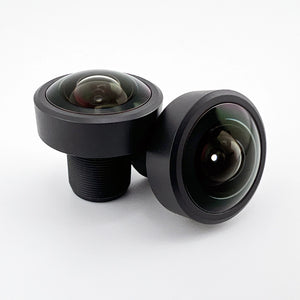
Commonlands stocks IR-corrected M12 lenses built for this. The CIL046 4.4mm M12 lens is RGBIR corrected at F/2.0 for 1/1.7" sensors up to 8MP, with an optional 650nm cut filter. The CIL290 1.9mm M12 fisheye is IR corrected for 1/2.7" sensors up to 5MP, with an optional 660nm cut filter. Both ship with or without the filter installed, so one optical design serves a fixed-filter build or a switcher-equipped one.
Whether a lens needs IR correction depends on how many bands it serves, not on whether a switcher is present. A daytime-only color camera or a fixed NIR-only night camera each works in one band, so a standard lens holds focus. A dual-band build needs IR correction, through a switcher or a filterless module that images visible and ambient NIR at once.

Should I Use 850nm or 940nm NIR Illumination?
850nm and 940nm are the two common NIR illumination wavelengths for surveillance, and the choice trades range against covertness. Most CMOS sensors keep meaningfully more quantum efficiency at 850nm, so it gives more usable signal and longer effective range at the same illuminator power. The cost is a faint red glow visible near the illuminator.
940nm is close enough to invisible that most people will not see the illuminator operating, which matters for covert or aesthetically sensitive sites. The tradeoff is that most sensors respond less strongly at 940nm, so range or image quality drops unless the sensor and lens are selected for that wavelength.
The lens's own role is narrow: an IR-corrected lens has to hold focus across whichever band the illuminator uses, and its coating and glass transmission should be checked against that wavelength. A lens validated at 850nm is not automatically corrected at 940nm. The 850nm versus 940nm guide has the sensor-side quantum efficiency comparison.
Range itself is a system calculation, not a lens spec: it depends on illuminator power, beam angle against the lens field of view, sensor sensitivity, and weather. Match the beam angle to the field of view, since a lens wider than the beam leaves its edges dark, and remember that published range figures assume a moderately reflective subject.
What Aperture Is Best for a Low-Light Surveillance Lens?
Wide open at night is a starting point, not a rule: a lower F# collects more light per unit time, the main lever for nighttime image quality once illumination power is fixed. Stopping down slightly can still win when the design is soft or vignettes wide open, when focus and thermal drift tighten at full aperture, when flare rises, or when the scene needs depth of field, and more illumination or a longer exposure can buy back the light.
The Commonlands CIL522 12mm C-mount lens has an adjustable iris that opens to F/1.4, so it runs wide open for light throughput at night and stops down in daylight to control glare and extend depth of field. That adjustability is the practical advantage C-mount holds over fixed-aperture M12 outdoors, where illumination is only partly controllable.
The CIL046 ships at a fixed F/2.0, fast for a compact board lens but with no iris ring to trade throughput for depth of field or glare control.
Stopping down past a point costs sharpness to diffraction, and small pixels meet it early: at the 1.5 to 2.2µm pitches common in surveillance sensors, the Airy diameter (d = 2.44λN) reaches twice the pixel pitch around F/2.2 to F/3.3 at 550nm, and near F/1.4 to F/2.1 under 850nm illumination.
Treat that two-pixel marker as a Commonlands starting heuristic rather than a limit: the falloff is gradual, and depth of field, aberration cleanup, exposure headroom, or the task's own MTF requirement can justify stopping further down or staying wider. The low-light lens guide covers the F#, throughput, and diffraction relationship.
Aperture is one lever among exposure time and sensor gain. Longer exposure risks motion blur, and raising gain does not add photons. A faster lens avoids both costs and brings its own: larger and pricier optics, shallower depth of field, more aberration and vignetting wide open, tighter focus tolerance, and more stray light, before T-stop transmission losses.
Should a Surveillance Camera Use a Fixed or Varifocal Lens?
Fixed focal length lenses are simpler, more compact, and often less expensive, and they are the practical choice once mounting distance and required coverage are known before installation. A camera over a fixed doorway rarely needs a different field of view after commissioning, so a fixed lens removes an adjustment and a failure point. It also holds a wider maximum aperture than an equivalent varifocal at the same price.
Varifocal lenses let an installer set focal length and field of view on site without swapping the optic. That flexibility earns its cost when mounting distance is not final until the installer is on the pole, when one model serves several coverage requirements across a deployment, or when the coverage requirement may change later.
Commonlands offers fixed-focal-length lenses and M12 varifocal options. Confirm each model's adjustment range and focus behavior. If the coverage requirement is well defined, the focal length selection guide is usually the more cost-effective path. The fixed versus varifocal guide covers the full comparison.
Range Versus Coverage: What Distance Can a Lens Actually Resolve?
A wide-coverage lens and a long-range lens solve different problems, and no single lens does both well at one sensor resolution. Shorter focal lengths spread pixels across a wider field. Longer ones concentrate them on a narrower scene. Surveillance frames this as a pixel-density hierarchy rather than a single field-of-view number:
| Relative pixel density | What a viewer can conclude | 代表的な用途 |
|---|---|---|
| 低 | Something is present, a moving shape against the background | Wide-area situational awareness |
| 中程度 | Object class: a person versus a vehicle versus a foreground object | General monitoring |
| より高い | Distinguishing detail: clothing, vehicle type, gait | Matching a known subject or vehicle against a reference |
| 最高 | Fine detail: facial features or license plate characters | Positive identification |
Each tier up the hierarchy roughly multiplies the pixels-per-meter requirement, shortening usable range at a fixed focal length. Decide which tier the installation needs at its farthest distance, then size focal length and sensor resolution to hit that pixel density there. Verify the geometry with the field of view calculator.
Treating one camera as capable of every tier across its full field is the common mistake. A wide camera may provide identification detail at short range while providing only detection detail farther away. Local sampling, lens MTF, perspective, and illumination determine where each task is possible, so test across the field. That is why layouts pair a wide camera with a longer lens on a chokepoint. Roadway and intersection work is a separate problem with its own telephoto and working-distance needs. See lenses for traffic monitoring.
Matching Sensor Format and Resolution to the Surveillance Lens
For rectilinear lenses, the image circle has to cover the sensor diagonal with margin, or the corners vignette regardless of how well the rest of the specification matches. Fisheye coverage depends on the lens-sensor pairing. A circular fisheye fits the full circle within the sensor's short side. A full-frame fisheye covers the diagonal, while a smaller sensor crops part of the available field.
The CIL046 covers up to 1/1.7" sensors at 8MP. The CIL290 fisheye's 5.8mm image circle pairs with 1/2.7" sensors because of that cropped-circle exception. The CIL542 covers 1.1" sensors at 25MP.
Resolution and pixel pitch matter independently of physical sensor size. More megapixels on the same sensor means smaller pixels, which raises spatial resolution but shrinks each pixel's light-gathering area, generally raising noise at a given illumination. The lens needs usable MTF at the sensor's Nyquist frequency, or optical blur becomes the limit and the extra megapixels add little. The sensor size and lens compatibility guide covers the vignetting and resolving-power mechanics.
When two image-circle ratings are close, the larger one is the safer default for coverage, but a lens built for a larger format may not resolve a small-pixel sensor's Nyquist frequency, and its chief-ray-angle geometry can mismatch the sensor's microlenses. Verify resolving power and CRA against the specific sensor rather than assuming.
Environmental Sealing for Outdoor Surveillance Cameras
A lens needs its own ingress protection rating only when it is directly exposed to weather rather than sitting behind a sealed housing dome or window. Where a sealed enclosure protects the lens, the enclosure's IP rating governs and the lens rating is secondary. A lens-level rating matters for board-level and open-frame designs where the front element faces the environment.
Commonlands stocks select M12 lenses with a lens-level ingress rating. The CIL290 1.9mm fisheye is IP67 rated to IEC 60529 as well as IR corrected. Not every lens is sealed or coated, and the same optical design sometimes ships in both sealed and unsealed mechanical variants, so verify the specific SKU before a board-level outdoor build.
IP67 under IEC 60529 covers the tested lens variant in its mounted configuration against dust and temporary immersion in water. It does not cover jets, steam, detergents, repeated sanitation cycles, UV, salt, or condensation, and it does not extend to the camera body, connector, or cable unless those are separately rated.
Confirm ratings at the system level before committing to a fully exposed mount. The IP rating guide has the full scale, and select C-mount lenses add harsh-environment hardening covered in the ruggedized lens guide.
Top Lenses for Day/Night Surveillance Cameras
For day/night surveillance the lens follows the imaging job: an IR-corrected M12 lens such as the CIL046 when the camera has an IR-cut filter switcher, a fast adjustable-iris C-mount lens such as the CIL522 for low light, and a fisheye such as the CIL290 when one camera has to cover a wide entry. The four below are current Commonlands stock optics.
How we picked: every entry is a shipping Commonlands SKU with specifications published on its product page. EFL and F# come from those pages. Confirm sensor-format coverage before ordering.
| シナリオ | レンズ | マウント | EFL | F# | この選手を選んだ理由 |
|---|---|---|---|---|---|
| IRカット切り替え機能付きの日夜切替 | CIL046 | M12 | 4.4mm | F/2.0 | RGBIR補正が施されているため、可視光から近赤外(NIR)への切り替え時にもフォーカス位置を維持します。最大1/1.7インチ、8MPのセンサーに対応しています。 |
| 低照度環境での日中のアイリス制御 | CIL522 | Cマウント | 12mm | F/1.4 | Adjustable iris opens to F/1.4 at night for light throughput, then stops down by day for glare control and depth of field. |
| Identification-tier detail from pixel density | CIL542 | Cマウント | 12mm | F/2.8~F/16 | On a 1.1" sensor, 12mm frames a wide-normal view near 61° horizontal, so reach comes from sampling: the 25MP class puts more pixels on a subject at any distance, holding higher detail tiers farther out. IR corrected for day/night operation. |
| 広範囲にわたる単一カメラによる撮影 | CIL290 | M12 | 1.9mm | F/2.2 | 出入り口用カメラ向けの190°魚眼レンズ。オプションの660nmカットフィルターによるIR補正機能を備え、IP67規格に準拠しています。 |
EFL and F# values are from the current product pages. Verify coverage on your sensor first.

Technical references
よくある質問
昼夜兼用の監視カメラには、どのレンズを使えばいいですか?
カメラに機械式のIRカットフィルター切り替え機構が搭載されている場合は、IR補正済みのレンズを使用してください。これは、レンズが可視光のみの昼間モードと、近赤外線(NIR)を含む夜間モードの両方で、フォーカス位置を正確に維持する必要があるためです。 CIL046 4.4mm M12レンズおよびCIL290 1.9mm M12魚眼レンズは、この目的のためにIR補正が施されており、オプションで650nm/660nmカットフィルターが用意されています。スイッチャーがない場合は、代わりに製造時に固定のIRカットまたはIRパス構成が設定されます。
防犯カメラには、850nmと940nmのどちらの近赤外(NIR)照明を使用すべきでしょうか?
850nmはセンサーからの信号が強く、有効射程も長くなりますが、イルミネーターからかすかな赤色の光が可視光として漏れます。940nmは人間の目には実質的に見えませんが、ほとんどのセンサーはこの波長に対する感度が低いため、センサーとレンズが940nm用に特別に調整されていない限り、通常、検知距離と画質が低下します。検知距離を最優先し、目立たない照射が必須ではない場合は、850nmを選択してください。
低照度環境での監視用レンズには、どの絞り値が最適ですか?
A faster (lower F#) lens collects more light per unit time, which matters most at night when illumination is limited. The CIL522 12mm C-mount lens has an adjustable iris that opens to F/1.4, letting the same lens run wide open at night and stop down for depth of field and glare control in daylight. M12 low-light options such as the CIL046 ship at a fixed F/2.0, which is fast but not adjustable.
監視カメラには、固定焦点レンズとバリフォーカルレンズのどちらを使うべきでしょうか?
単焦点レンズは構造がシンプルでコンパクト、かつ多くの場合安価であり、取り付け距離や必要な撮影範囲が確定しており、かつ変動しない場合には実用的な選択肢となります。可変焦点レンズを使用すれば、設置業者は光学系を交換することなく現場で視野角を調整できるため、取り付け距離が設置時まで確定していない場合や、撮影範囲の要件が後で変更される可能性がある場合に役立ちます。
監視用レンズはIP67規格に準拠している必要がありますか?
Only if the lens itself is directly exposed to the elements rather than sitting behind a sealed camera housing dome or window. The Commonlands CIL290 1.9mm M12 fisheye carries an IP67 rating under IEC 60529, which covers the tested variant as mounted against dust and temporary immersion, not jets, steam, chemicals, or UV. Most of the catalog carries no rating at all. If the lens sits behind a properly sealed enclosure, the enclosure's rating governs.
監視カメラ用のレンズ選びについて、アドバイスが必要ですか?
Commonlands engineering can work through IR correction, NIR wavelength matching, aperture, and sensor format before you commit to hardware.