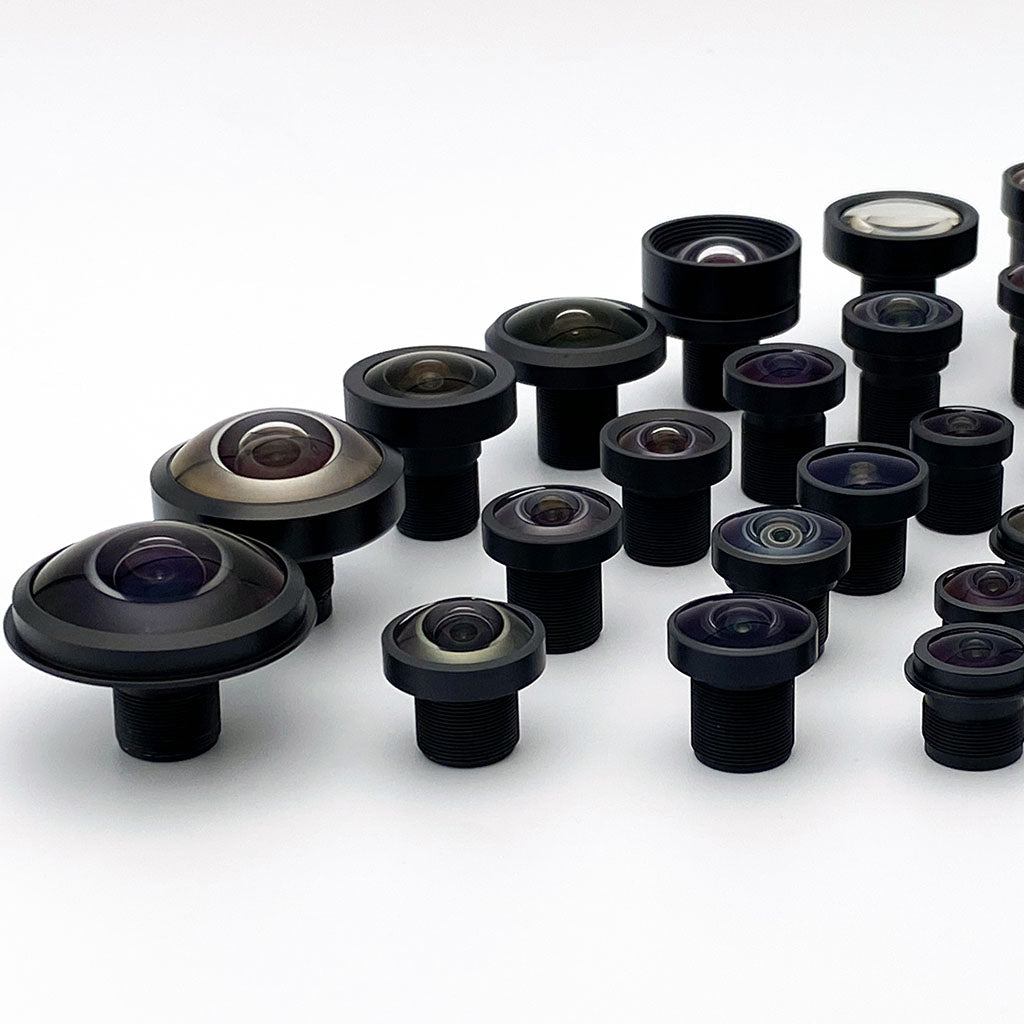

Working Distance and Minimum Object Distance for Machine Vision
Start with the space between the lens and the part. Then check framing, focus travel, and image quality at that distance.

Working distance (WD) is the gap from the front of the lens housing to the object in this guide. Minimum object distance (MOD) is the closest distance specified for the lens under stated focus or performance conditions. Confirm the supplier’s measurement reference. Reaching focus at the center does not guarantee sharp corners.
Define the Distance and Field of View
Measure working distance from the stated front reference to the surface you want to image. A conveyor, robot gripper, or protective enclosure may limit that space. Keep WD adjustable while the layout is still flexible.
Next, specify the field of view (FOV): the width and height of the scene the camera must capture. Sensor size and WD together determine the focal length needed for that framing. The field-of-view calculator provides a starting estimate.
For paraxial imaging in air, magnification m is image size divided by object size. Object distance u is measured from the front principal plane, an optical reference that may sit inside or outside the housing.
For example, a 7.2mm sensor width imaging a 400mm field gives m = 0.018. If u is 800mm, the calculated focal length is about 14.1mm. A housing-measured WD is not automatically the same as u. Kingslake and Johnson explain principal planes in Lens Design Fundamentals, §3.3.
Depth of field is the range of object distances that remain acceptably sharp at one focus setting. It depends on framing, aperture, and the detail requirement. Moving the camera while changing focal length to keep the same framing does not necessarily increase it; see the depth-of-field guide.

Check What Minimum Object Distance Means
A published MOD describes a limit under the supplier's stated conditions. Ask whether it means center focus, a specified image-quality threshold, or the end of adjustment travel. Some datasheets omit MOD, so request it with the sensor format and operating aperture.
An adjustable C-mount lens often reaches its near limit at the end of focus travel. The mechanism may move the whole lens cell or selected groups. Internal group motion can compensate aberrations, but C-mount itself does not require that design.
A fixed M12 optical assembly focuses by moving as a unit in its holder. Usable travel depends on thread engagement and clearance to the sensor stack. Aberrations can limit image quality even when the holder reaches center focus. A fixed-focus camera has a usable object range that must be checked as an assembly.
Keep Mechanical and Optical Distances Separate
| 数量 | Meaning | 使用方法 |
|---|---|---|
| 作動距離 | Gap from the stated front reference to the object | Machine layout and part clearance. |
| Minimum object distance | Closest object distance under the supplier's stated conditions | Checking the usable focus range. |
| Principal-plane object distance | Distance from the front principal plane to the object | Paraxial focal-length and magnification calculations. |
As an object moves closer to a positive lens, its real image generally forms farther behind the lens. Increasing lens-to-sensor spacing can therefore bring a closer object into focus. Confirm which mechanical surfaces the drawing uses before translating that spacing into a holder height.
Test Center and Corners at Short Range
A lens is corrected for an object-distance range. Moving outside that range can change field curvature, astigmatism, and spherical aberration. The center, corners, or both may become limiting; similar focal lengths do not guarantee similar close-range performance.
Test an aligned target at the nearest and farthest required distances. Compare detail at the center and opposite corners while adjusting focus. If the best settings differ, decide whether one setting still meets the task's contrast requirement. Check tilt before blaming the lens design.
Closing an adjustable iris can improve tolerance to focus differences, but costs light and eventually increases diffraction blur. Test at the aperture the illumination can support. The aberrations guide explains the common symptoms.
An extension tube or greater M12 extension moves the focus range closer and usually sacrifices infinity focus. It does not recorrect the lens. Edmund Optics' spacer guide explains the magnification change and possible image-quality tradeoffs.

Choose Samples From the Required Geometry
Compare lenses that cover the sensor and required field at the available WD. For compact assemblies, check M12 holder travel and clearance. An adjustable iris can make a C-mount design useful when you need to tune depth of field.
A finite-conjugate lens is corrected for an object at a finite distance. That label does not promise equal performance at every close distance. Ask for data at your operating distance and test the complete camera.
Send the active sensor dimensions, pixel pitch, nearest and farthest object positions, illumination band, and smallest feature to be measured. Include the available mounting space. Use the lens collection to identify candidates for that comparison.
よくある質問
How is working distance measured?
In this guide, WD runs from the front of the lens housing to the object surface. Confirm the reference in the supplier’s drawing, especially when a hood or protective window extends ahead of the lens.
How does MOD differ from working distance?
WD describes the camera layout. MOD describes the closest object distance specified for the lens under stated conditions. Check whether the supplier means focus travel, center focus, or a performance requirement across the image.
Why are corners blurry at short working distance?
Changing object distance changes the balance of lens aberrations. Field curvature and astigmatism can make the corners prefer a different focus setting, while tilt can produce similar symptoms. Test center and opposite corners through focus before assigning a cause.
Should I choose M12 or C-mount for close imaging?
Either can work if the selected lens meets the framing and image-quality requirements. M12 often suits compact packaging; an adjustable iris can help tune a C-mount setup. Test the lens at the actual distance and sensor size.
Can an extension tube focus closer?
Increasing lens-to-sensor spacing can move the focus range closer, usually at the expense of infinity focus. It also changes magnification. Check clearance and image quality, because extension does not correct aberrations at the new distance.

References and Further Reading
- Kingslake and Johnson, Lens Design Fundamentals, 2nd ed. (2010). Academic Press, §3.3. Publisher-hosted excerpt on principal planes and focal lengths.
- Edmund Optics, Imaging System Parameter Calculator. Working-distance convention and the limits of simple focal-length estimates.
- Edmund Optics, Fixed Focal Length Lens C-Mount Spacer Kit. Extension, magnification, and image-quality considerations.
- Optikos, How to Measure MTF and Other Properties of Lenses. Conjugate-distance and through-focus measurements.
Find a Lens for Your Working Distance
Send your sensor, field of view, and available working distance. Commonlands engineering can help compare lens options and identify the measurements needed for your application.