

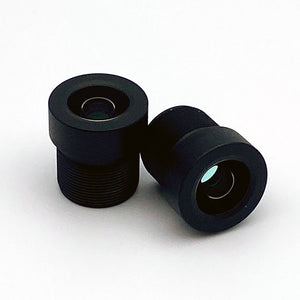
ロボット用のM12レンズの選び方
要は、画角、歪み、そして絞りの3つの要素に尽きます。これらは互いにトレードオフの関係にあり、適切なバランスは、ロボットのカメラに実際にどのような役割が求められるかによって異なります。
視野:カバレッジ対解像度
Wider FOV means more spatial coverage but less angular resolution per pixel. For obstacle avoidance, coverage wins: a 215° fisheye kills blind spots, though it introduces heavy barrel distortion. For SLAM feature tracking, a 6mm low-distortion lens gives you cleaner feature correspondence over a narrower view. A lot of production robots run both: fisheye for surround awareness, rectilinear for the primary nav direction.
当社のFOV計算ツールを使用して必要なFOVを算出するか、EFL計算ツールを使用して目標角度から逆算することができます。
歪み:アルゴリズムが処理できる範囲
Optical distortion reaches your vision pipeline through the camera model. ORB-SLAM, VINS-Mono, and similar systems work from a calibrated model, so what matters is how well that model fits your lens out to the corners, not whether the number clears a particular percentage. No universal threshold exists. Correction is cheaper than its reputation too: a precomputed remap runs fast on a Jetson, and fisheye-native front ends skip rectification altogether.
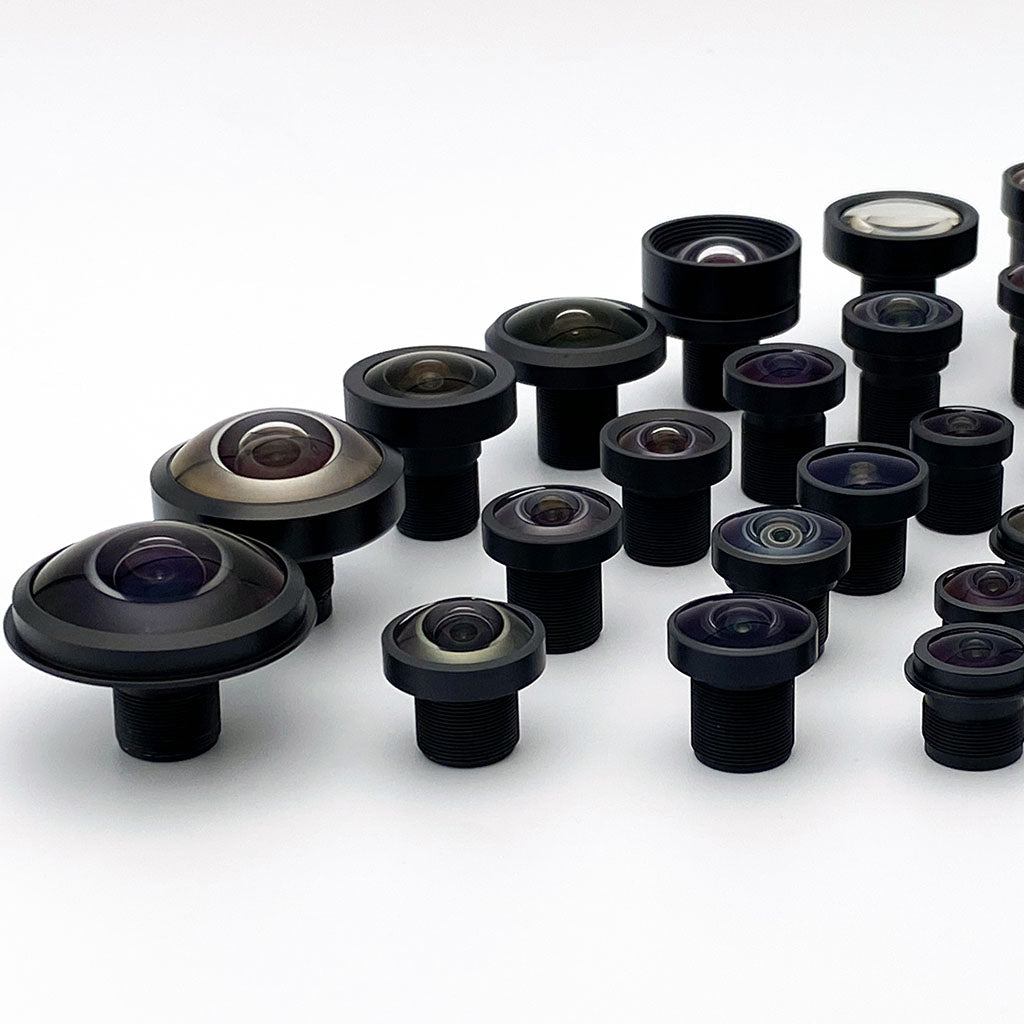
If you want the least distortion for the model to absorb, the CIL034 is the flattest lens in this set at roughly 0%, though its product page does not state which distortion metric that figure uses. The CIL023 is the wide option at 2.2mm and -5% TV distortion on a 4:3 frame.
障害物検出スタックがすでにフィッシュアイモデルに対応している場合(たとえば、OpenCVのフィッシュアイモジュールなど)、190°のフィッシュアイレンズは、歪みがあるにもかかわらず十分に機能します。ソフトウェアが歪みを補正するため、レンズは可能な限り広い視野を提供してくれます。
絞り:集光力と被写界深度
Fast apertures let in more light, which matters in warehouses, parking garages, and dusk operation. The CIL327 (2.7mm, F/1.5) is the fastest lens in this set; at a standard field of view, the CIL059 (5.9mm, F/1.7) and the CIL061 (6mm, F/1.9) are the quick options. The catch: faster aperture means shallower depth of field. Objects at different distances won't all be sharp.
There is no single F-number that puts 30cm to infinity in focus. Hyperfocal distance falls out of focal length, F-number, and the circle of confusion you are willing to accept, and that last term follows your pixel pitch and how much edge blur the algorithm tolerates. A 2.7mm lens reaches a near hyperfocal at a much lower F-number than a 7.2mm lens does on the same sensor.
Run your own focal length, F-number, and sensor format through the DOF calculator, and treat the result as geometry rather than physics: stopping down buys less than the geometric depth suggests once diffraction takes over. We can send measured depth-of-field data for a given lens if the margin looks tight.
環境保護
A warehouse AMR probably needs no rated lens at all. A delivery robot in Seattle needs the sealing somewhere, and you choose where. Rain-exposed builds usually evaluate IP67 lenses that seal at the barrel first; skipping a window and housing becomes an architecture option, taken only after validating the installed assembly. A standard lens sitting behind a window that the housing already qualifies carries no IP code of its own, and that is often the cheaper answer. If your robot gets pressure-washed, ask us about IP6K9K (industry shorthand IP69K) options.
Read any rating narrowly. It applies to the tested lens variant in its mounted configuration under the standard's water and dust exposures (IEC 60529 for IP67, ISO 20653 for IP6K9K, which are separate tests under separate standards). It does not cover steam, detergents, repeated sanitation cycles, UV exposure, condensation inside the barrel, or the rest of the camera.
センサーの互換性
M12レンズにはすべてイメージサークルがあります。これがセンサーの対角線よりも小さい場合、四隅が暗くなる(ヴィネット現象)現象が発生します。ロボット工学で一般的に使用されるセンサーのフォーマット:
- 1/4" (4.5mm diagonal) — the smallest common module format
- 1/3インチ(対角6.0mm)— ロボット工学分野で最も一般的なフォーマットで、レンズの選択肢が豊富
- 1/2.7" (6.7mm diagonal) — a common low-light robotics format
- 1/2インチ(対角8.0mm)— 高解像度用途
詳細な寸法については、当社のCMOSセンサーサイズリファレンスをご参照ください。お使いのセンサーがどれか分からない場合は、データシートをお送りいただければ、適合する製品をご提案いたします。