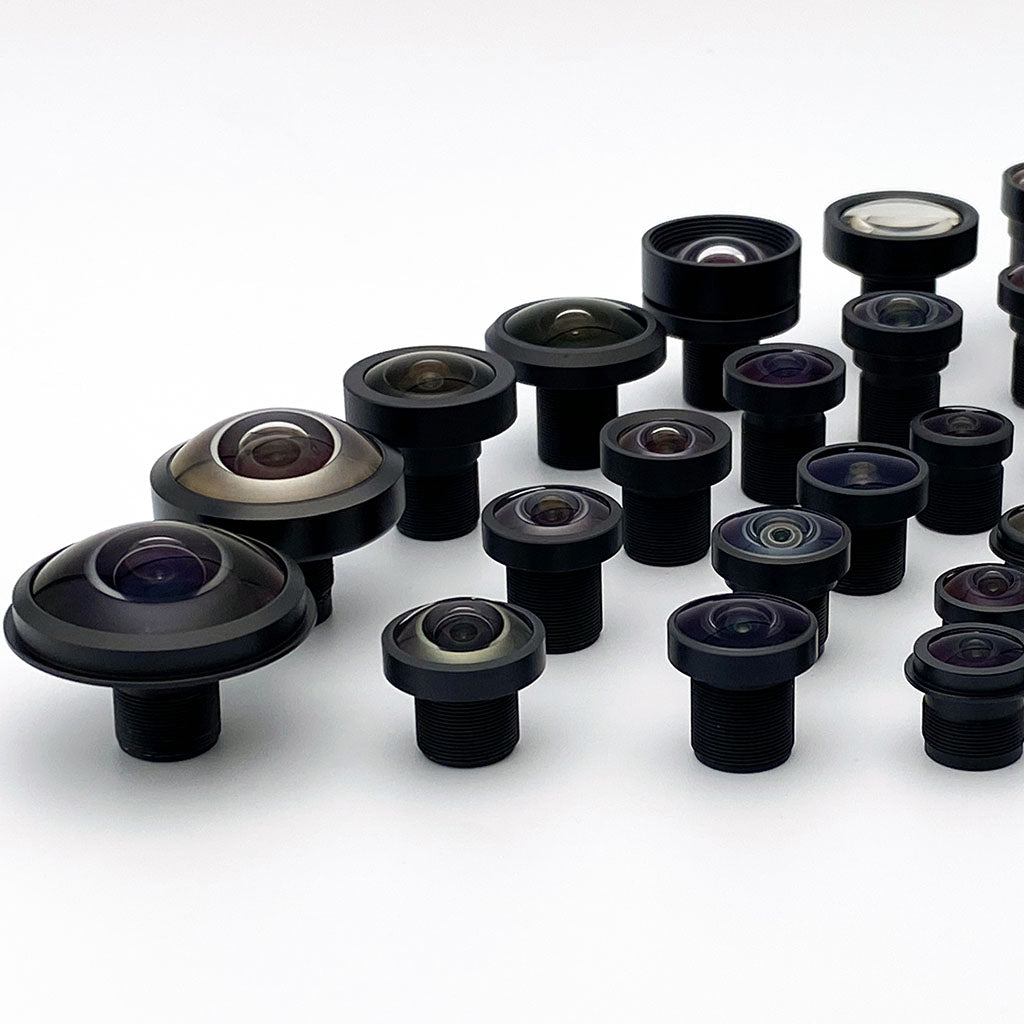

マシンビジョンの視野:計算方法、画角、およびよくある落とし穴
The FOV formula takes three inputs, and it fails for three reasons: nominal sensor names, distortion, and fisheye projection. This guide covers the formula, the angle-of-view relationship, and the checks that keep the numbers honest.

Field of view (FOV) in machine vision is the physical size of the scene the camera captures at a given working distance. For a rectilinear lens it is FOV = (sensor width × working distance) / focal length, a far-conjugate approximation (distance from the entrance pupil in the pinhole model), where sensor width is the active imaging dimension in millimeters, not the nominal format name.
The formula fails when engineers use nominal sensor dimensions, ignore lens distortion, or apply it to fisheye lenses. Verify final numbers with the field of view calculator before ordering hardware.
マシンビジョンにおける「視野」とは何ですか?
Field of view (FOV) in machine vision is the physical area of the scene the camera captures at a given working distance, expressed in linear units at the object plane. A 120mm horizontal field of view means the camera sees a 120mm-wide strip at the inspection distance.
FOV is not a property of the lens alone. It depends on three inputs:
- A longer focal length narrows the field of view.
- A larger active sensor widens the field of view.
- Moving farther from the object widens the field of view.
Change any one of these and the field of view changes, which makes FOV a system-level calculation, not a lens spec lookup. Working distance is a design variable early in a project and fixed once the mechanics are committed. The Commonlands working distance guide covers that tradeoff.

カメラの画角はどのように計算するのですか?
For a rectilinear lens, horizontal field of view equals active sensor width times working distance, divided by focal length. Use the active sensor dimensions from the camera datasheet, not the nominal format name. The angular projection is anchored at the entrance pupil, not the principal planes or the housing front. In wide-angle and retrofocus designs these points sit many millimeters apart.
Horizontal and vertical coverage use the same relation with the corresponding sensor dimension, and the diagonal follows from Pythagoras. The relation is a far-conjugate approximation, close when the working distance is long compared with the focal length. At short conjugates use thin-lens conjugates: with m = sensor width / scene width, f = WD × m / (1 + m), measured from the object-side principal plane (Hecht, Optics, 5th ed., §5.2).
Use the active imaging width from the camera datasheet, not the nominal format name. A sensor labeled 1/2" has an active width near 6.4mm. Entering 12.7mm (half of 25.4) produces a result nearly double the real field of view.
解き方の例
1/2.3インチセンサーの有効幅は約6.17mmです。6mmのレンズを使用し、作動距離が300mmの場合:
目的の画角から焦点距離を選ぶ
撮影対象のサイズが分かっている場合、焦点距離を求めるために式を整理します:
Round to an available focal length and re-check the coverage: a 12mm lens gives 213mm and a 16mm lens gives 160mm at that distance. The Commonlands focal length selection guide walks through the tradeoff.
Average ground sample distance is FOV_H divided by the pixel column count. It describes sampling, while resolved detail also depends on lens MTF, motion blur, noise, and processing. The Commonlands spatial resolution guide covers how it interacts with lens MTF and pixel size.
画角と視野の違いは何ですか?
Angle of view is an angular property of the lens and sensor, measured in degrees, and stays effectively constant except at close focus, where focus breathing shifts the effective focal length and distortion, so the angle drifts. Field of view is the physical scene coverage, in millimeters, that the angle produces at a specific working distance on a specific sensor. The two are related by FOV_H = 2 × WD × tan(AoV_H / 2).
| プロパティ | 画角(AoV) | 視野(FOV) |
|---|---|---|
| 単位 | 学位 | ミリメートル、メートル、またはインチ |
| 作動距離によるのでしょうか? | Effectively no. Fixed for a lens and sensor pair except at very close focus | Yes. It doubles when working distance doubles |
| こんな時に便利 | レンズの仕様、センサーフォーマットの比較 | 既知の検査距離におけるシーンのカバー範囲 |
Because sensors are rectangular, the angle differs by axis: HFOV uses the active width, VFOV the active height, and DFOV the diagonal. On a 6.3mm × 4.7mm active area, a 4mm lens gives roughly 76° HFOV, 61° VFOV, and 89° DFOV. Datasheets do not always state which axis a quoted angle uses, so check before comparing lenses.
Use the Commonlands angle of view calculator to confirm a lens and sensor combination hits a target angle.
焦点距離とセンサーサイズは、画角にどのような影響を与えるのでしょうか?
Field of view scales directly with active sensor width and inversely with focal length: doubling the sensor width doubles the FOV, and halving the focal length doubles it. Angle of view responds nonlinearly, so short focal lengths need tighter specification. The same scaling lets pairings match: an 8mm lens on a 2/3" sensor and a 6mm lens on a 1/1.8" sensor give similar horizontal coverage at the same distance.
有効領域と公称フォーマット名
Nominal sensor format names are historical designations from tube camera outer diameters. They do not describe the imaging-area size, and using them as dimensions corrupts the FOV calculation:
| 名目形式 | 一般的な有効幅(mm) | 一般的な有効高さ(mm) | 「format fraction」を幅として使用するとエラーが発生します |
|---|---|---|---|
| 1/4インチ | ~3.6 | ~2.7 | 6.35mmを使用すると、誤差は約76%になる |
| 1/3インチ | ~4.8 | ~3.6 | 8.47mmを使用すると、誤差は約76%となる |
| 1/2.3インチ | ~6.17 | ~4.55 | 11.04mmを使用すると、誤差は約79%となる |
| 1/2インチ | ~6.4 | ~4.8 | 12.7mmを使用すると、誤差は約98%になる |
| 1/1.8インチ | ~7.18 | ~5.32 | 14.11mmを使用すると、誤差は約97%となる |
| 2/3インチ | ~8.8 | ~6.6 | 16.93mmを使用すると、誤差は約92%となる |
Active dimensions vary by manufacturer and pixel count within a nominal format, so check the specific camera model. The CMOS sensor size guide explains the naming convention, and the Commonlands image sensor reference lists active dimensions for common sensors.
なぜ、歪曲、魚眼投影、および像円によって、実際の答えが変わってしまうのでしょうか?
The rectilinear FOV formula assumes straight lines map to straight lines on the sensor. Barrel distortion and fisheye projection depart from that mapping. An undersized image circle is a separate coverage problem that can clip the field or leave the corners too dark or soft.
Barrel Distortion Splits Coverage Into Raw and Usable
Barrel distortion makes the formula answer two questions with one number, so read its result against the quantity you care about:
| 数量 | What barrel distortion does | Formula error |
|---|---|---|
| Total angular field | Local magnification falls with field height, so the lens sees more scene than a rectilinear lens of the same focal length | Understates the true angular coverage |
| Usable low-distortion region | Geometry stays accurate only over a smaller central radius | Overstates the coverage you can measure on |
| Edge pixel scale | Each edge pixel covers more scene, so a rectified image must stretch the edges back out | Understates the scene width each edge pixel spans |
Many standard machine vision lenses approximate rectilinear projection closely enough that the gap is small. Departure from that model depends on projection and distortion correction, not focal length alone, and wide-angle designs show it most. Treat the formula result as a rectilinear reference field. The true raw field follows the measured projection and distortion curve. Derate for the low-distortion region the task needs, and specify low-distortion lenses for measurement or alignment. The Commonlands low distortion lens guide covers how they are specified.
魚眼レンズの場合は、まったく異なる計算が必要となります
Fisheye lenses do not follow the rectilinear model. They use alternative projections such as equidistant, equisolid, stereographic, or orthographic mapping. The sensor-size-to-angle arctan formula must be replaced with the appropriate projection model. Once the actual boundary-ray angle is known, W = 2d tan(θ/2) still gives coverage on a centered plane perpendicular to the optical axis for a symmetric field below 180°. Fields at or above 180° have no finite width on that plane. Common fisheye mappings include:

A 180° fisheye images a 90° half-angle cone, and converting that to a scene width needs the projection function, not the tan formula. Use the manufacturer's mapping data, which the Commonlands fisheye and wide-angle distortion guide treats in depth.
イメージサークルとセンサーのクロップ率
Lenses project a circular image. If the sensor diagonal exceeds the lens image circle, the corners vignette or degrade first. The horizontal and vertical edges lose coverage only if the circle cuts inside the sensor's width or height, set by circle diameter and sensor aspect ratio. If the image circle is larger than the sensor, the sensor crops the projection: a lens rated for 2/3" sensors on a 1/2" sensor sees a narrower angle than its datasheet states.
Verify the image circle covers the sensor diagonal, and calculate with your sensor's active dimensions. The Commonlands sensor size and lens compatibility guide covers both failure modes.
どのレンズが、広角、標準、狭角の画角をカバーしていますか?
Focal lengths from 2.6mm to 25mm produce horizontal fields of view from roughly 712mm down to 74mm at 300mm working distance.
画角帯別トップレンズランキング
These five Commonlands lenses span the range at a fixed working distance, ranked widest to narrowest, from the CIL227 190° fisheye to the CIL250 25mm telephoto.
| FOVバンド | レンズ | マウント / EFL | 掲載記事 | 最適な用途 |
|---|---|---|---|---|
| 超広角フィッシュアイ | CIL227 2.7mm フィッシュアイ | M12、2.7mm | 8.0mmのイメージサークルにおける190°の視野角(等距離投影) | セキュリティ、ドローン、および存在検知における半球範囲のカバー |
| ワイド | CIL059 6mm 低歪み | M12、6mm | 76° FOV at an 8.8mm reference circle | Wide coverage. −4% Rectilinear needs calibration before measurement |
| ワイド | CIL062 6.2mm | M12, 6.2mm | ~347mm at 300mm WD on a 1/1.8" sensor | Budget coverage at −2% rectilinear distortion. Calibrate before gauging or alignment |
| 中 | CIL531 8mm Cマウント | Cマウント、8mm | 2/3インチセンサー、300mmのワーキングディスタンスで約330mm(水平画角約58°) | 12MP 2/3インチセンサーにおける可変アイリス式被写界深度制御 |
| 中望遠 | CIL250 25mm 望遠 | M12、25mm | 1/2.3インチセンサー、焦点距離300mm、ワーキングディスタンス74mm(水平視野角約14°) | より長い作動距離での微細部検査 |
Coverage figures come from the 300mm scene-coverage table later in this section or the lens product-page datasheet. The fisheye value is equidistant-projection coverage, not a rectilinear formula result.
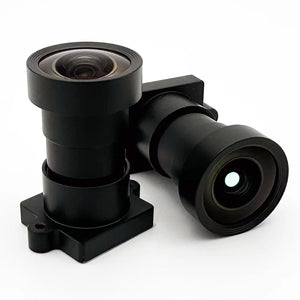
300mmの撮影距離において、焦点距離が被写界範囲に与える影響
This Commonlands reference table shows approximate horizontal field of view for rectilinear lenses at 300mm working distance on common sensor formats. All values use active sensor widths.
| 焦点距離 | センサーフォーマット | 有効幅(mm) | 300mmのWDにおけるFOV_H(mm) | 補償区分 |
|---|---|---|---|---|
| 2.6mm | 1/2.3インチ | 6.17 | ~712 | 非常に広い |
| 6mm | 1/2.3インチ | 6.17 | ~309 | 標準 |
| 6mm | 1/1.8インチ | 7.18 | ~359 | スタンダード(大型センサー) |
| 8mm | 2/3インチ | 8.8 | ~330 | 標準(Cマウント) |
| 25mm | 1/2.3インチ | 6.17 | ~74 | 望遠/狭角 |
The C-mount row adds an adjustable iris, so stopping down extends depth of field when a target field of view also carries a depth requirement.

よくある質問
マシンビジョンにおける「視野」とは何ですか?
マシンビジョンにおける視野(FOV)とは、所定の作動距離においてカメラが捉える被写体の物理的な領域のことで、物体平面上でミリメートル単位で測定されます。水平視野が120mmであるということは、その距離においてカメラが幅120mmの帯状の領域を捉えていることを意味します。視野は、焦点距離、有効センサーサイズ、および作動距離の組み合わせによって決まります。
マシンビジョンの視野角はどのように計算すればよいですか?
For a rectilinear lens: FOV_H = (sensor width × working distance) / focal length, all in millimeters, a far-conjugate approximation (distance from the entrance pupil in the pinhole model). Use the actual active sensor dimensions, not the nominal format name. A 1/2" sensor has an active width of approximately 6.4mm, not 12.7mm. To find the focal length for a target FOV, rearrange: f = (sensor width × working distance) / target FOV. Fisheye and high-distortion lenses need a projection-corrected calculation.
なぜ広角レンズや魚眼レンズは、視野角(FOV)の単純な計算式が成り立たなくなるのでしょうか?
標準的な計算式は、直線投影を前提としています。これは、被写界内の直線がセンサー上の直線に写し出されるというものです。樽型歪みを持つ広角レンズは画像の端を圧縮するため、歪みのない有効な撮影範囲は、この計算式による予測とは異なります。一方、魚眼レンズはまったく異なる投影モデル(等距離投影または等体積投影)を採用しているため、arctan や tan を用いた計算式は全く適用されません。
水平画角、垂直画角、対角線画角の違いは何ですか?
Horizontal AoV (HFOV) uses the active sensor width, vertical AoV (VFOV) uses the active sensor height, and diagonal AoV (DFOV) uses the sensor diagonal. For a rectangular sensor, DFOV is the largest of the three. Lens datasheets may quote any axis without saying which, so check before comparing lenses. DFOV can exceed VFOV by more than 30 degrees on a 16:9 sensor.
目的の画角から焦点距離をどのように選べばよいでしょうか?
Rearrange the FOV formula, a far-conjugate approximation with distance from the entrance pupil in the pinhole model: f = (sensor width × working distance) / target FOV, all in millimeters. Start from the active sensor width in the camera datasheet, the working distance your system geometry dictates, and the required scene coverage. Round to the nearest available focal length, then verify the resulting FOV with the Commonlands field of view calculator before ordering hardware.
目標の視野範囲に合わせるのに困っていませんか?
Commonlands US-based optical engineers can review your sensor, working distance, and inspection geometry and recommend a specific lens. ISO 9001:2015 certified. Orders placed before 12 PM PST ship the same day from San Diego.