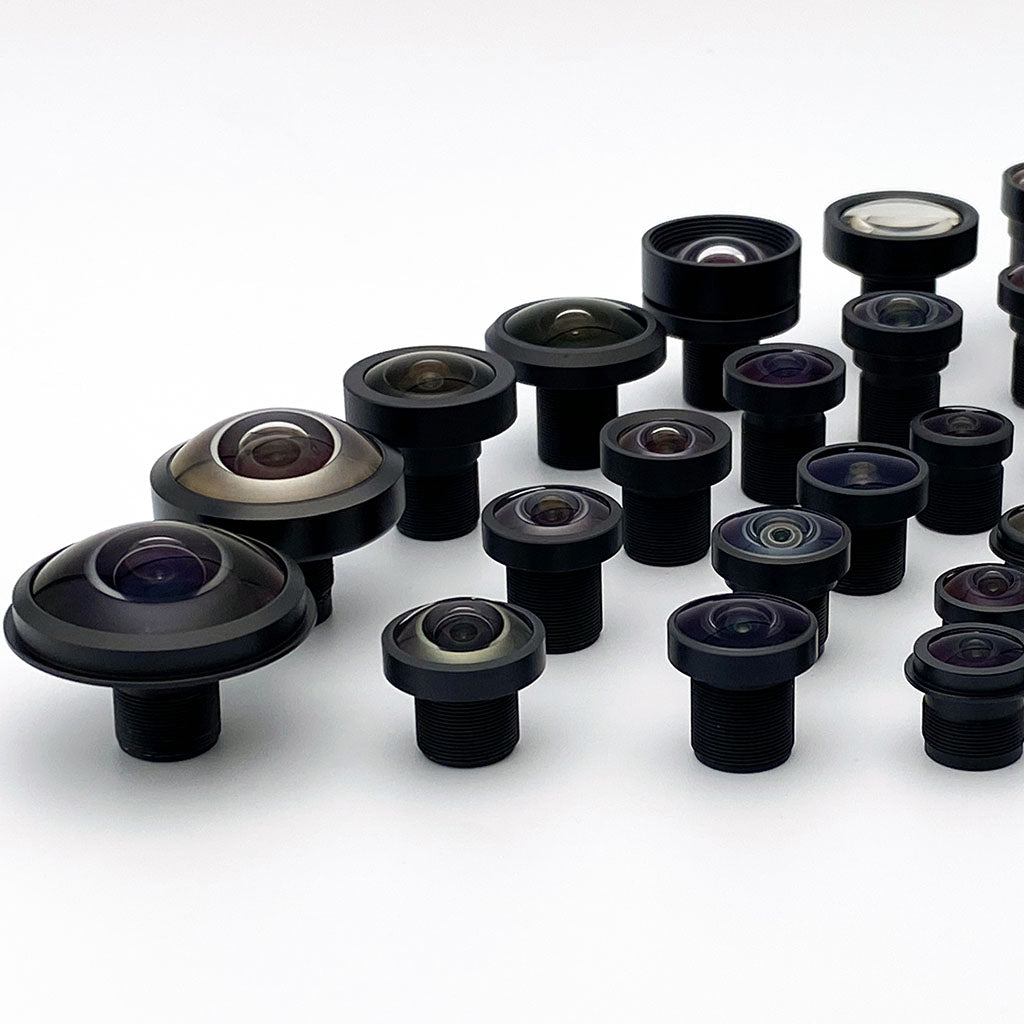

マシンビジョンにおいて、被写界深度はなぜ重要なのでしょうか?
被写界深度は、鮮明で信頼性の高いマシンビジョンの基礎となる要素です。被写界深度によって、被写体のどの部分が ピントが合っており、どの部分がぼやけるかが決まります。これは、コンピュータビジョンアルゴリズムが 特徴点を検出したり、バーコードを読み取ったり、ロボットの動きを正確に制御したりできるかどうかに直接影響します。
被写界深度(DoF)は、カメラの「ピントが合う範囲」と考えてください。浅すぎると、重要な被写体がぼやけてしまいます。 深すぎると(F値を小さくする必要があるため)、高速シャッタースピードに必要な十分な光量を確保できず、 代わりに動きによるブレが生じてしまう可能性があります。
簡単な目安
If the required range extends to infinity, hyperfocal focusing can provide useful near-to-infinity coverage for a stated blur limit. For a finite inspection or manipulation range, choose focus and aperture around that interval, then verify contrast at its nearest and farthest points.
電卓の計算結果は、実際にはどういう意味なのでしょうか?
| パラメータ | そこから読み取れること | 代表値 | アプリケーションへの影響 |
|---|---|---|---|
| 近方焦点限界 | 被写体が鮮明に見える最短距離 | 0.2m~2m | Nearest object distance meeting the selected geometric blur limit at this focus setting |
| 遠方焦点限界 | 許容できる鮮明度で撮影できる最遠距離 | 1m - ∞ | Farthest object distance meeting the selected geometric blur limit, not a detection-range prediction |
| ハイパーフォーカル距離 | 被写界深度を最大限に広げるには、ここにピントを合わせてください | 0.5m~10m | 最適な固定焦点設定 |
| 総自由度 | 近限と遠限の範囲 | 0.1m - ∞ | 作業可能範囲のサイズ |
| サークル・オブ・コンフュージョン | 最大ボケスポットでも依然として「シャープ」に見える | 1~4ピクセル | 鮮鋭度の許容範囲 |
| ナイキスト周波数 | センサーのサンプリング限界(レンズのMTFによって解像度がそれより早く頭打ちになる場合がある) | 100~500 lp/mm | 分解能の限界 |
| 被写界深度 | センサーの位置決め公差 | ±10~100µm | 求められる機械的精度 |
自分の用途に合った設定をどのように選べばよいですか?
移動ロボットのナビゲーション
- 目標:モーションブラーを最小限に抑える
- 焦点距離:2.8~6mm
- 絞り:f/1.4~2.8
- 特集:ハイパーフォーカル
- CoC:2~4ピクセル
ピック&プレース用ビジョンシステム
- 目標:作業距離での鮮明な視界
- 焦点距離:6~25mm
- 絞り:f/2.8~4
- 焦点:作業面
- CoC:1~2ピクセル
品質検査
- 目標:最高のシャープネス
- 焦点距離:12~35mm
- 絞り:f/2.8~6.0
- フォーカス:固定距離
- CoC:1ピクセル
これらの計算の背後にある物理的原理とは何でしょうか?
ガウス光学財団
この計算機は、薄レンズの式と幾何光学を用いて被写界深度を算出します。 基本の式は、被写体距離(u)、像距離(v)、焦点距離(f)の関係を示しています:
ハイパーフォーカル距離
ハイパーフォーカル距離とは、カメラをその距離にピントを合わせると、 ハイパーフォーカル距離の半分から無限遠までの範囲にある被写体が、選択した混同円において許容できるほど鮮明に写る距離のことです。
なぜ「サークル・オブ・コンフュージョン」が重要なのか
「サークル・オブ・コンフュージョン(CoC)」とは、ぼやけに対する許容範囲のことです。ピントが合っていない点光源は、 センサー上でぼやけた円として映し出されます。この円がCoCの閾値よりも小さい場合、 人はそれを「十分にシャープ」だと認識します。
CoCの選び方
One, two, and four pixels are possible trial blur allowances. None is a universal pass criterion. Test the required contrast, feature accuracy, and algorithm performance over the intended distance range.
Doubling the allowed circle of confusion approximately doubles depth of field only when the focus distance is well below the hyperfocal distance. Near hyperfocal focus, the far limit can move to infinity, so the relationship is nonlinear.
単純な自由度(DoF)の計算式は、どのような場合に通用しなくなるのか?
小口径における回折限界
回折の影響が顕著になるのは、エアリー円盤が画素サイズに近づいたときであり、マシンビジョンで一般的に使用されるような小さな 画素の場合、これはf/11よりはるかに早い段階で発生します。回折によって生じる エアリー円盤の直径は、おおよそ以下の通りです:
ここで、λは波長(緑色光の場合、≈550nm)、NはF値である。F/16の場合、これにより 約21µmのボケが生じる――これは多くの画素サイズよりも大きい!
実際のレンズ収差
実際のレンズは完璧ではありません。球面収差、コマ収差、非点収差といった問題があり、 これらは計算上の被写界深度内であっても解像度を低下させる可能性があります。マシンビジョン向けに最適化された高品質な M12レンズは、 多群構成の設計により、これらの収差を最小限に抑えています。
被写界深度を最大限に活用するためのプロのコツ
- まずは適切なセンサー選びから:画素が大きいほど、撮影の許容範囲が広くなります。3.45µm の画素を持つセンサーは、1.4µmの画素を持つセンサーに比べて、ピントの精度をそれほど求められません。
- Consider pixel binning: 2×2 binning doubles the sampling pitch. If the task allows a larger blur limit, acceptable depth of field increases at the cost of spatial resolution. Binning itself does not change optical defocus.
- Use the sweet spot: Many lenses perform best a stop or two down from wide open, often between f/2.8 and f/5.6, though the exact point varies by design and spatial frequency. Too wide and aberrations dominate. Too narrow and diffraction limits sharpness.
- Set aperture for the required depth: Compare through-focus contrast at f/5.6 and f/11 to balance defocus, aberrations, and diffraction. Add illumination to recover exposure after stopping down. Extra light at f/5.6 does not provide the geometric depth of field of f/11.
- 実際のターゲットでテストを行う:まず計算を行いますが、必ず 具体的なパターンやコントラストレベルを用いた実環境でのテストで検証してください。
センサー技術は被写界深度にどのような影響を与えるのか?
モノクロセンサーとカラーセンサーの比較
モノクロセンサーは、各画素が 輝度情報をすべて捉えるため、一般的に有効解像度が高くなります。一方、ベイヤー型カラーセンサーでは、各画素が1つの色 チャネルしか捉えないため、補間処理が必要となり、その結果、エッジがぼやけることがあります。
| センサーの種類 | Spatial sampling | エッジの鮮明度 | おすすめ |
|---|---|---|---|
| モノクロ | One broadband sample per pixel | Depends on optical MTF and sampling | 計測、検査、SLAM |
| バイエルRGB | One color sample per pixel. Demosaicing reconstructs RGB | Depends on scene spectrum, direction, and demosaicing | 物体の分類、仕分け |
| RGB-IR | Visible and IR samples share the pixel grid | Depends on mosaic layout and reconstruction | 昼夜監視 |
グローバルシャッターとローリングシャッターの比較
被写界深度の計算には直接影響しませんが、グローバルシャッター方式のセンサーは、 すべての画素が同時に露光されるため、動的なロボット工学の用途において重要です。ローリングシャッター方式では、 ピントの問題のように見える歪みが生じることがありますが、これは実際には時間的なずれによるものです。 グローバルシャッター方式の画素には画素内記憶回路が追加されるため、 通常、画素サイズは大きくなります。同じ解像度であれば、画素サイズが大きいほどセンサーフォーマットも大きくなり、 特定のレンズにおける視野角が変化します。また、画素サイズが大きくなると、画素ベースの混同円が緩和され、 被写界深度が深まります。
オートフォーカスと固定焦点、どちらが良いのでしょうか?
ロボット工学における固定焦点の利点
Choose the focus setting for the required near and far object distances. Hyperfocal focus is useful when the required far limit is infinity. A finite inspection interval may need a different setting.
この計算ツールを使用して最適な固定焦点位置を算出した後、機械的に、あるいは ネジロック剤を使用して固定してください。 M12マウントのレンズの場合、 通常はレンズを正しい位置まで回転させて固定します。
被写界深度に関するよくある質問
撮影距離は被写界深度にどのような影響を与えますか?
For focus distances well short of the hyperfocal distance, depth of field grows roughly with the square of distance. Near the hyperfocal distance the far limit extends to infinity. At close range (macro), DoF might be just millimeters. At 10 meters, the same camera setup might have several meters of DoF. This is why close-up inspection requires very precise focus while surveillance cameras can use fixed focus for everything beyond a few meters.
ソフトウェアを使って被写界深度を広げることができますか?
はい、フォーカススタッキング(異なる焦点距離で撮影した複数の画像を合成する手法)や 計算によるデコンボリューション手法を用いることで可能です。ただし、これらには、 複数回の撮影(時間がかかる)か、あるいは相当な処理能力が必要となります。リアルタイムのロボット工学においては、光学的な被写界深度(DoF)が 通常、好ましいとされています。一部の新しいセンサーには、デュアルピクセルオートフォーカス機能が搭載されており、 深度マップを作成して、合成被写界深度(DoF)の生成を支援することができます。
被写界深度(DoF)とレンズのMTFにはどのような関係があるのでしょうか?
変調伝達関数(MTF)は、さまざまな空間周波数におけるコントラストを測定するものです。 被写界深度(DoF)の計算上は「ピントが合っている」レンズであっても、MTFが低ければコントラストが低下してしまいます。 MTFはピントがずれるにつれて徐々に低下するため、補正の優れたレンズほど、計算上の被写界深度範囲のより広い範囲で 実用的なコントラストを維持できます。エッジの鮮明さが重要な測定用途でレンズを選定する際は、 必ずMTFチャートを確認してください。
テレセントリックレンズは被写界深度にどのような影響を与えるのでしょうか?
Object-space and bi-telecentric lenses approximately preserve magnification as object distance changes. Image-space telecentricity alone does not provide this property. Real lenses retain telecentricity error, and their usable depth depends on magnification, aperture, blur, and task contrast. Check dimensional accuracy separately from geometric depth of field.
センサーの解像度と被写界深度、どちらを優先すべきでしょうか?
これは用途によって異なります。計測や検査の場合は、解像度を優先し、 焦点を適切に制御してください。物体検出や追跡の場合は、堅牢性を確保するために被写界深度(DoF)を優先してください。 覚えておいてください:高解像度の画像はいつでもダウンサンプリングできますが、 ぼやけによって失われた細部を復元することはできません。多くの成功しているロボットシステムでは、 最大解像度を追求するのではなく、被写界深度(DoF)に優れた2~5MP程度の中程度のセンサーが採用されています。
赤外線撮影における被写界深度についてはどうでしょうか?
シリコンセンサーで使用される近赤外波長(750~1000nm)は可視光よりも波長が長いため、 回折限界が大きくなり、焦点位置もわずかに異なります。多くのレンズは赤外光に対する補正が施されていないため、 焦点のずれが生じます。昼夜兼用用途では、赤外光補正が 施された専用レンズを選ぶか、可視光と赤外光の照明ごとに別々の焦点位置を設定するように計画してください。